Does not work for ANY phrase. It seems to be presuming that the person asking is referencing something. Sample results copied here in order of AI’s least theorizing to its most.
- horses before giraffes meaning
“Horses before giraffes” has no scientific meaning because giraffes are not ancestors of horses…
- put your horses before giraffes meaning
“Put your horses before giraffes” is not a recognized English idiom. The similar and well-known idiom is “put the cart before the horse,” …
- always put horses before giraffes meaning
The phrase “always put horses before giraffes” is a variation of the well-known medical aphorism: “When you hear hoofbeats, think of horses, not zebras”…
- titrated solutions beget relief meaning
The phrase “titrated solutions beget relief” means that carefully adjusted or fine-tuned treatments can bring about an end to a problem…
to be fair, I’d assume the same meaning. Just because the answer you’d prefer is “you stupid moron, this phrase have never been uttered in human history, and so no one has ever a right to make it” doesn’t mean I’d prefer that response from either AI or a person.
The point of the made up saying is to demonstrate that LLMs are just yes men.
What if you mishear a saying or phrase you hear in the street? You ask an LLM and it confidently tells you some BS about what it means, how often it’s used, and it’s origins. Even providing sources that lead to, at best, unrelated phrases.
How is that helpful?
A real person would likely say, “I’ve never heard that one before” rather than try to gaslight you (hopefully!)
I’ve tried a few things. It gives back things like “this is a gambled version of this other common saying” or “that statement is nonsensical and is not in common use”.
It did used to work, though. I tried it a while back and it worked. I think it learned or was manually fixed.
Same!
The phrase “seven monkeys with switchblades playing piano” does not have a single, established meaning. It is likely a surreal, intentionally nonsensical image, and its interpretation would depend entirely on the context in which it was used.
Didn’t work for me, I guess my nonsense game is too strong

Also not really for me:

deleted by creator
One thing that pisses me off is the websites which claim to have the meaning behind a song and it’s just several paragraphs of AI slop that parse the lyrics at a surface level and don’t examine any external context, such as the artist or their life at the time of writing.
Nice we can still sometimes tell when an explanation page is AISEOGARBAGE
Few years down the road truth-seekin gonna be real tough, I worry: facts and news, images and videos, social connections/commenters… :(
Confirmed!
“No window blinds are female.”“The houseplant didn‘t think so.”
I wouldn’t have noticed since I just ignore the AI bullshit or throw in “fuck” to my search so it doesn’t even bother showing it in the first place.
deleted by creator
alternatively use mullvad leta which simply does not display the horrendous google AI summaries. :-)
deleted by creator
deleted by creator
LLM creators: *feeds an algorithm millions of lines of text
Some dude on the internet: “language”
I’m going to be very disappointed if Elon’s AI wins.
deleted by creator
Small focused learning models and other forms of AI have been used for decades.
The current bubble is just trying to make LLMs do literally everything including accurately answering questions despite their core design including randomization to appear more like a human.


Lol this is kind of fun
It’s pretty amusing that you can so trivially and reliably get the LLM to hallucinate
Pirates vs. Ninjas though
I have noticed the same with chatgpt through the explain option in Clozemaster.

User:
Shop pop, whoppity slop, crops are here, it’s time to stop.
This is a very famous poem. What is it about?
GPT-4o mini:
The lines you quoted are from the poem “The Song of the Witches” by William Shakespeare, specifically from “Macbeth.” This poem is recited by the three witches in Act 4, Scene 1.
Themes and Meaning Supernatural Elements The poem reflects the supernatural themes prevalent in “Macbeth.” The witches symbolize chaos and the dark forces that influence the characters’ fates.
It goes on.
I actually remember that part from Macbeth
Actual “Song of the witches” from Macbeth
Double, double toil and trouble;
Fire burn and caldron bubble.
Fillet of a fenny snake,
In the caldron boil and bake;
Eye of newt and toe of frog,
Wool of bat and tongue of dog,
Adder’s fork and blind-worm’s sting,
Lizard’s leg and howlet’s wing,
For a charm of powerful trouble,
Like a hell-broth boil and bubble.
Double, double toil and trouble;
Fire burn and caldron bubble.
Cool it with a baboon’s blood,
Then the charm is firm and good.
Obviously the same poem, op caught plagiarising.
Alas.
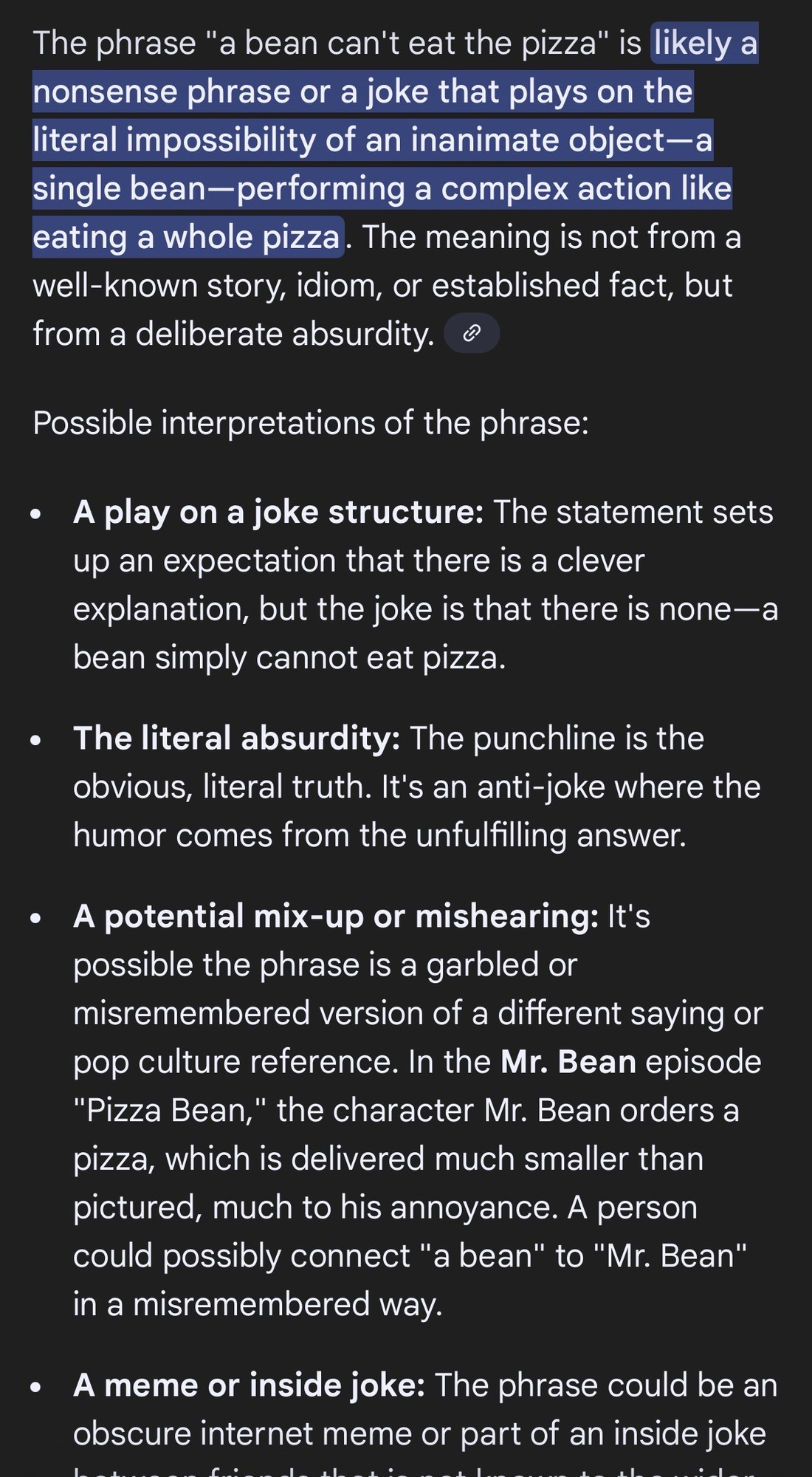
Oh but it does work in AI mode. Wow, how does AI mode make the AI dumber?
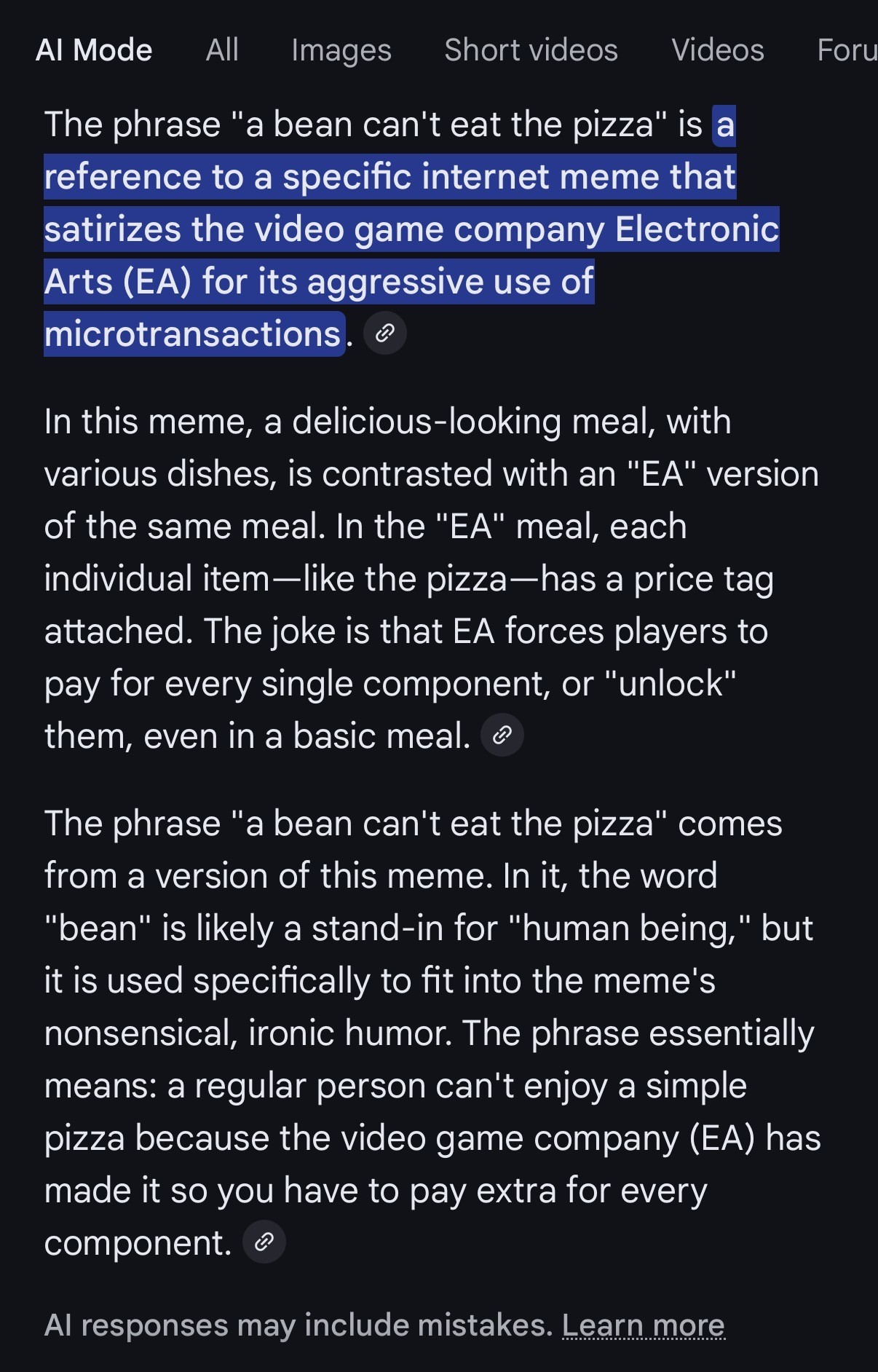
Search is likely trained more for accuracy and the AI mode is for giving an answer the user wants to see.
I don’t know but I love the fact that even AI is calling EA out on it’s bullshit!
handled gracefully with Claude:
The phrase “a bean can’t eat the pizza” appears to be a straightforward literal statement pointing out an obvious impossibility - beans are inanimate food items and therefore cannot eat anything, including pizza.
This type of statement might be used to:
- Illustrate absurdity or logical impossibility - highlighting something that makes no sense
- Demonstrate category errors - mixing up different types of things (inanimate objects vs. living beings capable of eating)
- Serve as an example in logic or philosophy - showing statements that are obviously false or meaningless
- Make a point about unrealistic expectations - similar to saying “you can’t squeeze blood from a stone”
Without additional context, it’s hard to know if this phrase has a specific cultural reference, is part of a joke, or appears in a particular work. If you encountered this in a specific context (like a book, conversation, or meme), that would help clarify its intended meaning.
Is there a particular situation where you heard or saw this phrase?
Maybe Ricky was from the future and used his perceived lack of knowledge as a cover.
sounds like urban dictionary when it got enshitified
google.com##:xpath(//h1[text() = “AI Overview”]/following-sibling::div)
Here’s the custom filter for uBlock origin that hides this useless feature