• 2 Posts
  • 18 Comments
Joined 2 months ago
cake
Cake day: April 30th, 2026

help-circle

  • Yeah, I’m in that boat. I did have some sugar, but it was extremely rare, and IIRC got phased out more as I got older. I don’t think it was ever a hard rule of “no,” but more of a “have very little except maybe on special occasions.” I never developed much of a taste for sweet things to the point I quite often find muffins for scones unreasonably sweet. When I was doing mountain bike races, I had energy chews and bars. In hinds sight, that was probably a poor nutrition choice for my metabolism, and I now I simply have roasted and salted pistachios, with a sugar free electrolyte mix before and/or after the ride.

    I also very much seem to be the exception here. Probably my experience more comes down to my own eccentricities. I have the eating habits and body type of a distance athlete; healthy but low weight, diet consisting largely of slow-burning foods like nuts, fruits and starchy vegetables. I am still figuring out what diet and training routine works best for me, but sugar, even as a mid-ride fuel is a hard no-go for me. I like putting in the work to be able to do extreme sports like mountain biking and snowboarding at a reasonably intense level all day long. I listen to my body and I know without a shadow of a doubt touching high sugar and certainly processed foods is not worth it by any means.





  • FedX@quokk.autome_irl@lemmy.worldme_irl
    link
    fedilink
    English
    arrow-up
    2
    ·
    7 days ago

    I have some wild helicopter watching stories. Best would probably be when there was a small wildfire a few miles away from my college. I was watching the flight tracker and saw them pull in a Huey and Blackhawk, and tracked down exactly where they were collecting water. Ditched class and went to watch them. They let us get like 100ft away from these ridiculous massive machines as they were taking on water. At one point, the Blackhawk pilot started playing chicken with us, trying to see if he could knock us off the hillside, LOL. Even still I will go out and watch most helicopters.


  • Agreed. In many ways the idea of ideology is a reductive concept. All ideologies hold some amount of merit and problems. If you try hard enough, there is even a decent argument to be made for kings (no, I’m not arguing for kings, I am simply using it as a talking point). I really don’t subscribe to any one ideology, and I don’t think most people here do either. I like aspects of anarchism, socialism, communism and georgism, all have merits, all have problems. I suspect most people here are the same, we all come to different conclusions from different life stories. We recognize the problem, but our plan for the future by no means has to look the same. Honestly, the “leftist infighting” is our greatest strength, not a weakness.


  • Thanks, that does help some. Eq 22 is what I was reading, and yeah, it’s a weird and confusing derivation. In reading Eq 22 closer, it’s helpful, but not as helpful as I would have liked. What’s funny in reading it is that it’s also in correlation to q, which I would have expected to be calculated in terms of v. sigh maybe it would be better if I went through and derived the equations myself, would probably be more useful that way anyway.


  • The posts about escape velocity (or speed if you prefer) are correct. To that I want to add the following: Gravitational effects technically never end with distance, only become weaker. It’s also important to note that every object has a gravitational field, it’s just that it needs to be ridiculously big for the force to have any real effect. Gravitational force can be described by the following equation: image
    where r is the distance between the two objects, and the rest does not matter for us today.

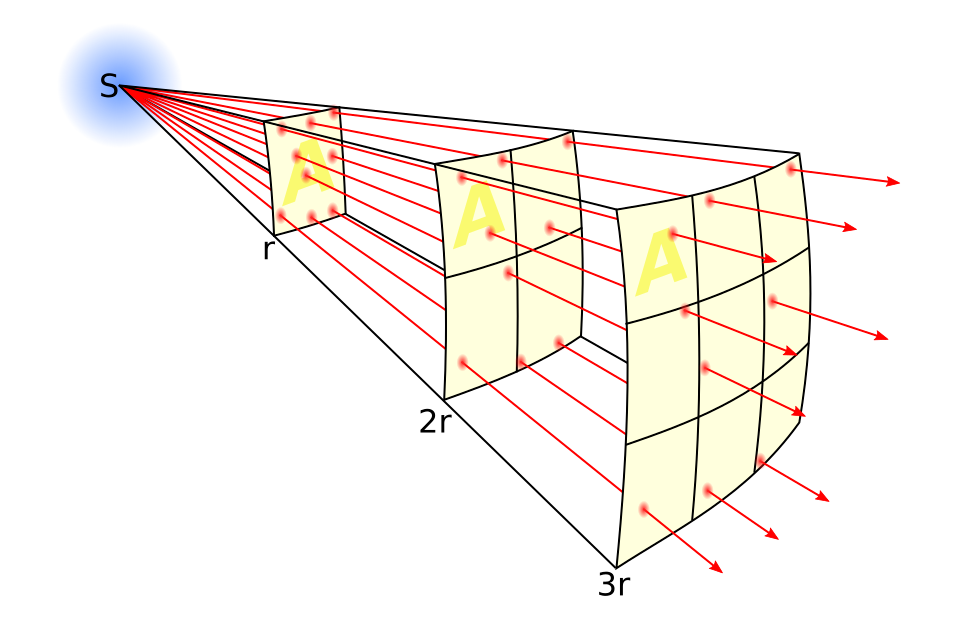
    This is the same as the inverse square law of light (this is a pretty good visual):

    image

    This means if you double the distance between yourself and a star, the strength of its light reaching you will quarter. This is also very similar to the math used to describe electric and magnetic field interactions, but I won’t go into that today.

    This is why scientists are able to measure gravitational waves from collapsing stars and quasars and stuff at the LIGO Gravitational Wave Observatory, just like how we can observe the light coming from distant stars. However, there is a point where the force of gravity becomes so weak as to be inconsequential, just like how at the edge of the solar system, the sun merely looks like a bright star. That is described as the gravitational sphere of influence, the rough approximation of the distance from a celestial body where it exerts the most gravitational force on a given object.

    Escape speed is the speed at which an object must travel, given a distance from said body, to escape its sphere of influence. The Earth+moon have a sphere of influence of about 9.29E5 km.