I mean, examples? Pretty much every ostensibly religious example I can think of off the top of my head is fundamentally driven by something else. Now that doesn’t make religion unimportant in these conflicts, but it’s not definitive and it’s entirely possible and/or likely other fault lines would’ve been found instead.
Having been through this conversation regarding slavery and the US Civil War, the tool we need is necessary and sufficient. Is a proposed cause of the war necessary for the war to have started? And is the proposed cause alone enough, by itself, to have started the war? If both conditions are true, then you can say that is the cause of the war.
I think if you look at least of a few of the European Crusades into Holy Land, you’ll see religion meets this standard.
Disclaimer: I think it’s obviously true that at least some conflicts can be considered to have been caused by religion, my issue is more in how common and how big those conflicts are.
So there are two problems here: First is the fact that these hypotheticals for the most part can’t be untangled with any degree of objectivity. Second is the question of how to evaluate religion’s impact on direction versus magnitude. Which is to say, it’s entirely possible that you have the conditions for a war that simply need something to shape them into a coherent conflict. Your example is actually pretty illustrative here, so lemme just:
I think if you look at least of a few of the European Crusades into Holy Land, you’ll see religion meets this standard.
The problem here is that religion was so tied up in the culture and institutions of the time that it’s nearly impossible to envision a Medieval Europe without religion (see first problem). The thing about the Crusades is that they were directed by the Church, which was eager to assert its influence, and you don’t even have the Church without religion. But then you don’t get nothing, because the other thing the Church was doing was trying to reduce conflict between Christians, so the Crusades were essentially the Church redirecting this violence externally; without that you don’t get less conflict, just different conflict (see second problem). Historically the lack of overarching authority to direct violence tends to lead to more rather than less violence (essentially a corollary of the square-cube law), so “just get rid of the authority holding a notoriously fragmented and warlike region together” isn’t exactly a recipe for less conflict. If we instead imagine that the authority holding Western Europe together was secular (as much as anything can be secular in this period), then the number of warlike fragmented regions that didn’t expand violently after being politically unified throughout history is indistinguishable from zero. The analogues here would be the Italians (under Rome) or Mongols, not exactly the most peaceful peoples.
So to get back to your heuristic, the Church undeniable caused the Crusades, but it’d be a much harder sell to say that without the Crusades there wouldn’t be something else in its place.
Sure, there’s always more going into a conflict that just one thing, the question is how do you sort out which ones are important enough to be considered causal.
I mean my counterargument here is that religion didn’t cause the Crusades (or a reskin thereof); the existence of an authority able to push the European nobility in the same direction did. You either remove that authority and get limitless endemic conflict or reskin that authority to make it non-religious and get different-looking conflict instead, and neither of these options are an upgrade over the Crusades in terms of amount of violence. Which is to say: Christianity took a whole host of potential conflicts and made some of them reality; it didn’t create conflict where none would’ve existed otherwise. For example, the English and French had been done Crusading into the Holy Land for only a few decades when the Hundred Years’ War hit.
On one hand, that’s a good point. On the other hand, even in such an extreme example you had nonsense like Catholic France fighting on the Protestant side in the Thirty Years’ War, so clearly they weren’t fighting for religion then. This means that even such a massive, explicitly religious conflict had a political dimension that could outweigh the religious dimension for some participants.


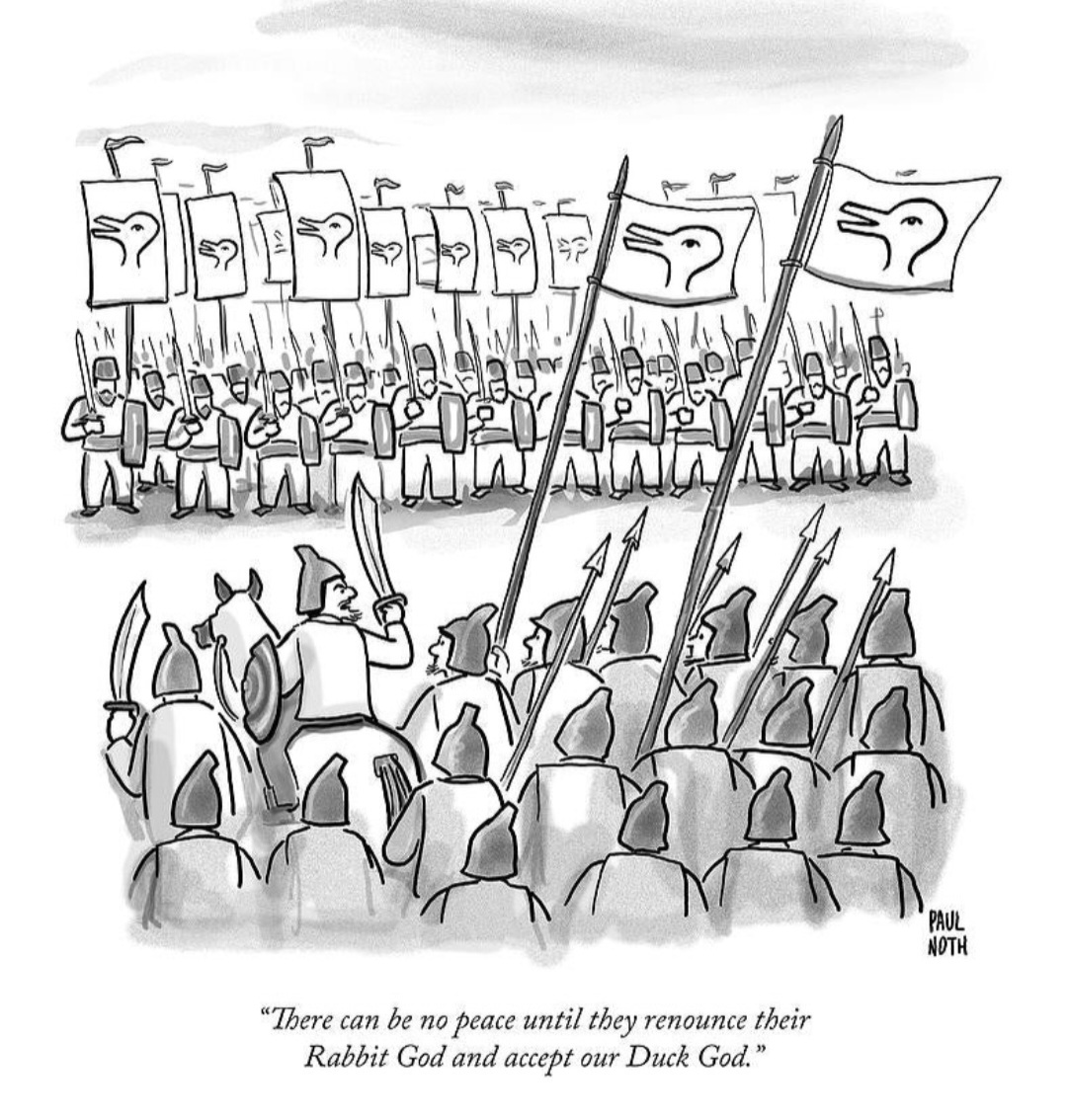
I mean, examples? Pretty much every ostensibly religious example I can think of off the top of my head is fundamentally driven by something else. Now that doesn’t make religion unimportant in these conflicts, but it’s not definitive and it’s entirely possible and/or likely other fault lines would’ve been found instead.
Having been through this conversation regarding slavery and the US Civil War, the tool we need is necessary and sufficient. Is a proposed cause of the war necessary for the war to have started? And is the proposed cause alone enough, by itself, to have started the war? If both conditions are true, then you can say that is the cause of the war.
I think if you look at least of a few of the European Crusades into Holy Land, you’ll see religion meets this standard.
Disclaimer: I think it’s obviously true that at least some conflicts can be considered to have been caused by religion, my issue is more in how common and how big those conflicts are.
So there are two problems here: First is the fact that these hypotheticals for the most part can’t be untangled with any degree of objectivity. Second is the question of how to evaluate religion’s impact on direction versus magnitude. Which is to say, it’s entirely possible that you have the conditions for a war that simply need something to shape them into a coherent conflict. Your example is actually pretty illustrative here, so lemme just:
The problem here is that religion was so tied up in the culture and institutions of the time that it’s nearly impossible to envision a Medieval Europe without religion (see first problem). The thing about the Crusades is that they were directed by the Church, which was eager to assert its influence, and you don’t even have the Church without religion. But then you don’t get nothing, because the other thing the Church was doing was trying to reduce conflict between Christians, so the Crusades were essentially the Church redirecting this violence externally; without that you don’t get less conflict, just different conflict (see second problem). Historically the lack of overarching authority to direct violence tends to lead to more rather than less violence (essentially a corollary of the square-cube law), so “just get rid of the authority holding a notoriously fragmented and warlike region together” isn’t exactly a recipe for less conflict. If we instead imagine that the authority holding Western Europe together was secular (as much as anything can be secular in this period), then the number of warlike fragmented regions that didn’t expand violently after being politically unified throughout history is indistinguishable from zero. The analogues here would be the Italians (under Rome) or Mongols, not exactly the most peaceful peoples.
So to get back to your heuristic, the Church undeniable caused the Crusades, but it’d be a much harder sell to say that without the Crusades there wouldn’t be something else in its place.
Sure, there’s always more going into a conflict that just one thing, the question is how do you sort out which ones are important enough to be considered causal.
I mean my counterargument here is that religion didn’t cause the Crusades (or a reskin thereof); the existence of an authority able to push the European nobility in the same direction did. You either remove that authority and get limitless endemic conflict or reskin that authority to make it non-religious and get different-looking conflict instead, and neither of these options are an upgrade over the Crusades in terms of amount of violence. Which is to say: Christianity took a whole host of potential conflicts and made some of them reality; it didn’t create conflict where none would’ve existed otherwise. For example, the English and French had been done Crusading into the Holy Land for only a few decades when the Hundred Years’ War hit.
The European wars of religion?
On one hand, that’s a good point. On the other hand, even in such an extreme example you had nonsense like Catholic France fighting on the Protestant side in the Thirty Years’ War, so clearly they weren’t fighting for religion then. This means that even such a massive, explicitly religious conflict had a political dimension that could outweigh the religious dimension for some participants.