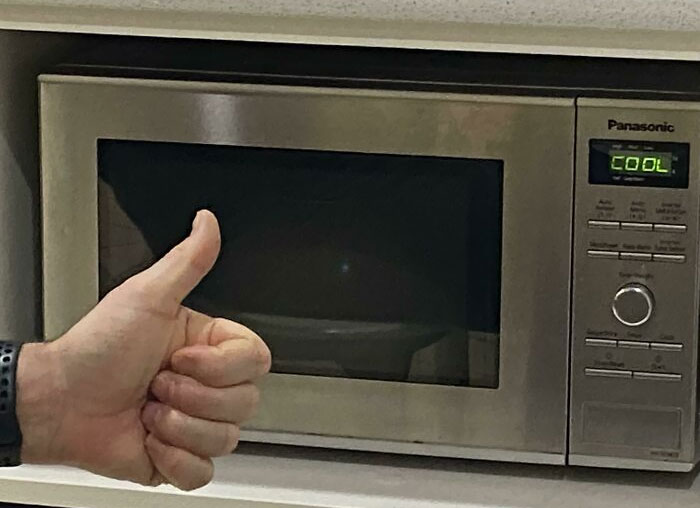
People like this think Trump is a genius
deleted by creator
Relevant exchange from Suicide Squad (the good one with Idris Elba and Flula, not the bad one with Will Smith and Jared Leto)
I dated someone who in earnest believed she has no accent. She didn’t understand what could be wrong about that.
I moved to California last year from Oklahoma. Occasionally I will say something about moving from Oklahoma and people are like, “oh that makes sense, you have a Midwestern accent sometimes”. We all sound normal to ourselves but everyone has an accent. Like the way California people say their O’s.
I have a hard time understanding the people in a freinds village and he lives 50km away
I guess it makes sense. I wouldn’t understand you either from 50km away.
Lemmy: We’re just a bunch of dads
And Linux nerds.
Like the way California people say their O’s
As a Canadian, it’s all I can hear when they speak.
Midwesterners are the only people I’ve ever met who don’t think they have an accent. And I’m like “you have a midwest accent.” They’re stunned because to them it’s just a “normal” accent, and they know it must be so because it’s what the TV man talks like. Obviously I know midwesterners who know they have an accent and the TV man is trained to speak that way. But everyone else I meet and know knows their own accent and can recognize variations of it. They’re not so conscious of how they make their accent happen, obviously, since it is their own. But they know they sound different from other people
Part of that is, out side of a few regions of the Midwest that have a really unique accent.
Most of the Midwest is “nutural English”. Yes there’s an accent, but there is a huge lack of slang, regional quirks, and is widely one of the most understandable accents across every English speaking country.
It’s the “universal English accent” in a sense. It’s a large reason why call centers became so popular there. That and low costs.
Functionally Midwestern accent is in a way the English that’s so boring that the banality of it IS the accent. Lol it’s kinda funny.
It’s the “universal English accent” in a sense.
… for American English
No even when polled, British, Australian and Canadian find it easier to understand when spoken over the phone. When compared to any accent other than their own.
Again it’s the reason it’s the most commonly used accent when you need a one size fit all solution and you can’t get a local accent for every region your servicing.
When compared to any accent other than their own.
Yes…? Are you struggling with the concept of an agnostic accent? I’m talking about call centers here after all.
So, I’m from Seattle, basically, and for the longest time I thought no, I do not have an accent.
Then I learned that the reason I thought that was because well, the accent I have is basically the least distinct from the ‘General American English’ or ‘Region Indistinct American’ accent, out of all other regional accents…
With that ‘General American’ accent being what nationwide newscasters, voice actors and movie stars either developed on their own, or were trained into, for being easily intelligible to any other American accent/dialect speaker, or as just sort of a rounded approximation of ‘American’, with no specified regionality to the character.
Thats not to say the PNW or Cali or just general US West accents are all exactly the same as ‘General American’… they are not… its just that they are the least difficult to understand from a general audience perspective out of other regional US accents/dialects… or at least that is the explanation I’ve heard.
As I am aware, the main difference between PNW/Cali English and other US regions is that we have completed the cot-caught merger. Absolutely no difference in pronunciation, the verb sounds are the same… whereas in much of the rest of the US, these are different, distinct vowel sounds. We just use the ‘cot’ pronounciation for both.
Bot cot thot slot thought caught fraught not spot dot.
All the same. No rolling or bending of the first vowel into the u to make a more complex vowel sound, all just ‘bot’ or ‘dot’.
That and pop vs soda vs coke.
For whatever reason, I usually say soda, but that did make me an oddball of most people around me near Seattle saying ‘pop’… but a lot of other places in the US use soda, but also a lot of other places use ‘coke’ to refer to any … soft drink… which confuses and aggrevates my Autistic brain lol.
…
There are a few things that I remember being distinct to Californian accents/dialects as compared to Seattle:
One is the rising tone at the end of the sentence… thing.
I always called this a valley girl accent, and this is because no one I knew as a kid spoke that way… unless their family had recently moved north, from Cali.
Now though, it is more common generally in the PNW, at least in my own experience… but also that could literally be because a lot of Californians have migrated north.
Another silly, but super easy tell someone isn’t from Seattle: Their accent may be essentially indistinguishable from a PNW accent… but they always, always refer to I-5, as ‘the 5’… instead of ‘eye-five’.
No one born and raised near Seattle does this.
I-5 is the main highway that goes all the way down from Vancouver BC, through Seattle, Portland, San Fran, LA, and runs through all of those cities, so its a major reference point of conversation in all those places.
And yeah, the regional vocab difference for how people refer to it is an example of a difference.
People in other countries use all sorts of crazy “languages”. We don’t bother with that here, we just talk normally.
Why can’t people just be normal. I am being my normal self, but other people seem different. Bastard freaks.
Language proficiencies: Common
Galactic Basic
No-one going to mention that they said countries and named two continents?
Because it reads like this:
“In other countries, like [those in] Europe or South America”.
No it doesn’t
Coming from a 'murican, it’s safer to assume they can’t name a single country when given a map
Read it again, d’you really think the same person who wrote that genuinely knows Europe isn’t a country?
I didn’t realize because I am too used to it.
exhales
At least they knew it was going to sound stupid.
I mean, they’re right. It does sound really stupid
Found the American.
Well, that did sound really stupid.
Coming soon:
What do you mean my US dollars aren’t accepted at any big intl. tourist locations anymore… I have to actually exchange them?
The only places I’ve found that take USD are really poor places that really want USD, and maybe Mexico. Even some of those places will really take advantage of the exchange and you get way less than what the USD is worth if you just pay with USD.
I travel all the time and tourist locations, barring the ones I mentioned, don’t want anything to do with handling USD when tapping a card or phone to pay is vastly preferred.
And in the big touristy cities in Europe, there’s so many scam currency exchanges, while if you just take the time to go to official government exchanges, you get reasonable exchange rates. The problem isn’t the locals, the problem is that you didn’t do the research and you did a dum-dum. (Also fuck the people who are scamming tourists, that’s just low.)
Always check currency in the country you are traveling to, always check approx exchange rate. These are literally just two searches and you are never gonna get exchange scammed (if you use an exchange and not change on the street from random people and get fake or valueless cash).
At the risk of being that idiot ……
I’m still annoyed at crossing a border over an international bridge and having to exchange currency to pay the toll. There’s a good argument that situation should support both currencies at that border.
And of course the currency exchange at that toll did not allow exchanging the amount of the toll. Scammy ripoff of people trying to cross forcing them to exchange larger amounts than they need
Oh no I don’t find that idiotic, that is very annoying, literally anywhere, between any two countries.
I guess the workaround is to plan ahead and do your currency exchanges before hand, but at least in the US, if you do that in cash, well now you’re a drug smuggler or something if you’re brown and/or not in the best mood.
I mean, everybody just has the ability to open up bank account debit/credit cards in multiple currencies, right?
Your bank doesn’t do currency exchange?
Not my problem, pleb, stay in your geographically confined area with a particular force of monopolized violence.
Bank currency exchange is not available if you don’t know to plan ahead, and may not be convenient ever
There’s usually a $5 or more minimum, so less than that might as well be trash. Not convenient for tolls
The only option at the border was an ATM, where you can withdraw currency, converted from your bank, but in $20 increments.
Toll booths did not take credit cards or bank cards for an exact payment. This was before electronic tolling but that still might not be a thing at borders
deleted by creator
I think British style plugs are the best despite their bulkiness. For one they are easily fixed and are designed to be so.
If you don’t know what I’m talking about watch this: https://youtu.be/COWlYUvzgZI
idk i think our aussie plugs are a good middle ground: they’re about mid way between UK and US in size, are not reversible, don’t have a fuse (but laws govern the type of current things can handle: extension cords MUST be 10A which covers a standard 10A home circuit - i believe there’s some extra built into the rating too), power boards the same, and have a 10A safety switch built into them which prevents daisy chaining over the current just like the fuse
repairability probably not so good, buuuuut i’ve never had a cable break so maybe we do something different with the construction that solves that need?
Interesting rabbit hole to drill down into ……
I see the Aussie common plug and similarity to other countries. The picture shows partly insulated prongs which is a great safety feature I’ve never seen before
I don’t know whether it’s physically the same size but that’s 240v and US had similar variations at that voltage
Simple US plugs are also not (usually) reversible. Historically they weren’t but the standard changed decades (half a century?) ago to support polarized plugs with one blade wider than the other. If it matters, such as a light switch, the plug must be polarized and can only fit in one direction. For some things, like a sealed power supply it doesn’t matter
There’s always ancient outlets and ancient plugs that never got replaced but those are getting rare
If you want a bulky replaceable plug, you can get those at any hardware store. Meanwhile I’ll take the smaller more reliable, more durable and waterproof molded plastic plug
I’ll for repairability but the plug isn’t usually what breaks.
And these people vote…
I live in a country with two plug types and actually have to use a fuckload of converters
that sounds like hell lmao where
For power In the U.S. I have to use USB-A, USB-C, Lightning, cigarette lighter adapter, 110 plug without ground, 110 with ground, 220 - 3 types of connectors on those just for dryers, adapters still for mini USB, micro USB, and that’s all before we start to get obscure. Universal lightbulb plugs? Nah everyone had to fuck that up as well.
US used to be like that too. When polarized plugs first became a thing, they wouldn’t fit into older non-polarized outlets. It took decades for all those to be replaced and I’m sure they’re still out there. Somewhere
Still I have one (1) in a stairwell in my house. So far I’ve left it alone, partially because it also has a stupid piece of stair molding blocking part of its cover plate but mostly because I have never in all my years found any reason to plug anything in there.
Somebody probably originally intended it to be for a vacuum cleaner or something, but even the corded ones I’ve owned have had cords more than long enough to reach both ends of the stairs from a selection of other nearby, non-stupid outlets.
The funny thing is only the UK plug design is any good, all others are so much worse they should just give up and go home.
This is anti Australian rhetoric and I will not stand for it. You are all beneath us in plug game, UK included
According to Electroboom Australia is doing it right too.
Stand on one pointing up and tell me it’s good.
deleted by creator
Very cool, I guess there is a voltage adapter built in?
Nope. So don’t plug a 120V hairdryer or corded drill in those things.
deleted by creator
Yes for electronic devices that expect low voltage DC and have a converter, like laptops, phone chargers, etc.
But don’t try and take a 120V hairdryer on holiday and plug it in because it will certainly blow up.
You definitely need to distinguish “electrical” devices from “electronic” devices but a safer approach is to read the plug.
- A power supply (ex. Phone charger) will be stamped with a voltage range and power draw, which probably includes everywhere but you can match it against the electrical service where you are. You may need a plug adapter but a simple mechanical adapter is sufficient.
- an electrical appliance (ex. Hair dryer) plug is probably not stamped with electrical requirements so the safe approach is to only use it in the intended country