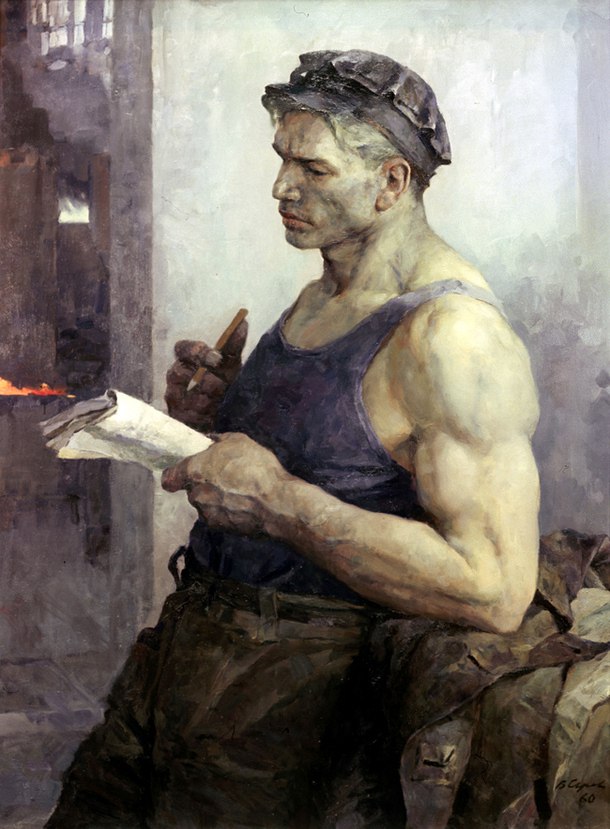
Maybe I haven’t explored enough but I see nobody praising his efforts for fixing Albania. Or the fact that he denounced Khrushchev and Zedong for being fake communists. Which he was right about them and other socialist leaders being revisionists. Hoxha stayed truthful to Marxism-Leninism and he followed Stalin’s path. You can say whatever you want, but I personally believe more people should make Hoxha a more popular revolutionary within this political community.
It was only a matter of time before they made this post, I’m only surprised by how long it took 😂
No way, is he back? Is Mr. Thermonuclear back from the Genzedong grave???
My immediate thoughts as well lmao
Wisconcom? She was active on hexbear for a bit.
because they are diffent type of marxist-leninist than the one you are thinking off
Bro is periodically trolling every 2 months, lets see how long he can keep it up!
Lmao
There is also
“…Or the fact that he denounced Khrushchev and Zedong for being fake communists. Which he was right about them and other socialist leaders being revisionists.”

Hoxhaism is a pruned branch, only interesting as a historical footnote. There are zero modern political projects informed by its theory.
Actually, Hoxhaism is fairly influential in Turkish Marxism. And there are Hoxhaist parties all around the world, even in Britain. We should critisize Hoxhaism’s dogmatic stances instead of dismissing it as irrelevant.
It is irrelevant, partially because of the dogmatism.
I know there are online adherents, and parties, I don’t care.
There aren’t countries and wins because it doesn’t work. And if it doesn’t work it doesn’t really matter (unless it’s for an example of what not to do).
We literally have an armed Hoxhaist party. Anarchists are actually irrelevant and we find the time and energy to critisize them, we can do the same for Hoxhaists, their dogmatic views are a lot more common than you realize.
That’s a neat example, I didn’t know that!
I honestly kind of feel the same about anarchists actually - the debate was fully settled by at least the 1930s, and there aren’t any wins or countries/political projects.
The Turkish example is cool, but I don’t really see it as a counterfactual here. They were a minor part in the failed political project of Rojava, so still no wins.
The Grad is typically similarly brusque when anarchists are brought up, ime, especially if the poster seems like they’re not in good faith.
No offense but the Soviet Union and Albania fell, while DRK and China stand to this day. It is dogmatic to ignore developments and try to hold on to a decisions made on a 1930s-40s material basis.
If anyone is able to provide material on the material conditions in Albania during the time of Enver Hoxha, please send them, as I still have only the highly propagandized anti-communist view that “Enver Hoxha turned Albania into North Korea” to go off of. I think it is critical in the assesment of him as a leader, that we have both the theoretical basis of the state as well as the material conditions that characterized it.
I know it ain’t much, but all I know about Socialist Albania comes from this post and it’s comments which doesn’t paint a rosy image of the country when it comes to their relationship with the Chinese and Hoxha’s disregard of the material needs of it’s citizens in favor of the Ideologically sticking it to the Soviets or the Chinese.
And what I was originally going to comment was in the line of “You are putting the crosshairs of the mods on yourself.” If these posts are not made in good faith, then I believe we have reason to be suspicious of you, comrade.
I want to read Enver Hoxha’s writing but calling Mao revisionist is just silly.

Why so hostile? You don’t need to denigrate Mao just because you like Enver Hodja. You can like both.
Your grasp of theory is clearly lacking. If you truly understood Marxism-Leninism, you would realize that it was precisely Stalin and the Stalin model that deviated from the standard understanding of Marxism-Leninism, rather than being the orthodox continuation.
Retaining a supplementary market economy to develop industry has been the orthodox viewpoint of early socialist development since Marx’s time. Marxism is not a philosophy of moralistic preaching. Its stance on private property is not based on the belief that “private property is morally evil.” Marxism is a science that uses evidence and material analysis to objectively examine the evolution of human society, build models, and use these models to predict future social trends.
The material basis of private property lies in the decentralization of production. However, as the production process becomes increasingly complex, the market will naturally tend towards the concentration of production; Marx called this concentration “socialization.” Lenin expanded upon this explaing how as competition transforms into monopoly and the socialization of production makes great progress, capitalists are unconsciously dragged into a new social order (an order transitioning from completely free competition to complete socialization. Production has been socialized, but ownership remains private) this is the fundamental contradiction.
Marx predicted that as enterprises expand, social instability will intensify until society cannot progress without resolving this contradiction. The key point is that socialized production is an inevitable consequence of the massive scale required by complex technologies. Large enterprises can not be simply dismantled without destroying their technological foundation; therefore, the surrounding ownership structure must be changed, transforming private ownership into public ownership. The necessary prerequisite being the expropriated industry must have already reached a sufficient degree of socialization.
If the state takes over an economic sector dominated by small-scale producers, a sector where production is not yet socialized and operations are not yet nationwide, the state is effectively taking over a sector that objectively lacks the infrastructure and technology required for nationwide operation. This introduces a new contradiction between socialized ownership and private production. A moralistic stance will ultimately lead to policies that contradict Marxist analysis, and are doomed to failure. Lenin, explained that nationalizing small producers is tantamount to economic suicide for any party attempting to do so. He also emphasized the necessity of learning to coexist with small producers.
The classless society envisioned by Marxism is not a society where private enterprises are prohibited and punished by law. Rather, it is a society where state-owned enterprises are so technologically and efficiently advanced that any private entrepreneurship is uncompetitive and inevitably bankrupt. What prevents you from starting a private enterprise is not the law, but the material conditions of the real world.
Understanding this, let’s look at the Stalin model. The system implemented by the Soviet Union was essentially a wartime economy designed to cope with the impending war against Germany. This was not the path to socialism generally envisioned by Marxists, but primarily a product of necessarily responding to the material reality of the approaching war in Europe; hence, it is called the “Stalin model” in Chinese literature. It is essentially a modification of classical Marxism. Many people imitated it because it was indeed effective in the short term, but this effectiveness only holds true when the economy is highly concentrated in established industry (heavy industry in this case).
When the shift to light industry was necessary, they encountered the contradiction predicted by classical Marxism: the state simply lacked the material infrastructure to meet all the needs of light industry nationwide. Thus, a black market spontaneously formed by small producers emerged to fill this gap. However, due to Soviet legal restrictions, the state was forced to continuously suppress these small producers who spontaneously compensated for the system’s deficiencies. This again confirmed Lenin’s warning: do not waste time trying to suppress small producers who spontaneously emerged due to the system’s economic inefficiency.
This situation fostered widespread corruption. Forced into illegal operations, they became part of the black market, an unregulated secondary economic sector. This group, already operating outside the law, would eventually use its influence to undermine the Soviet government. The collapse of the Soviet Union in 1991 was in no small part a result of these structural cracks being exploited by revisionists and imperialist forces.
The Stalin model was absolutely necessary under the historical conditions before World War II; this is beyond dispute. But to freeze wartime emergency measures into eternal dogma for peacetime is metaphysics.
Thanks for writing this. I like to see the perspective of Chinese Marxists on this topic.
Good read, thanks for explaining it in dialectical materialist terms.