
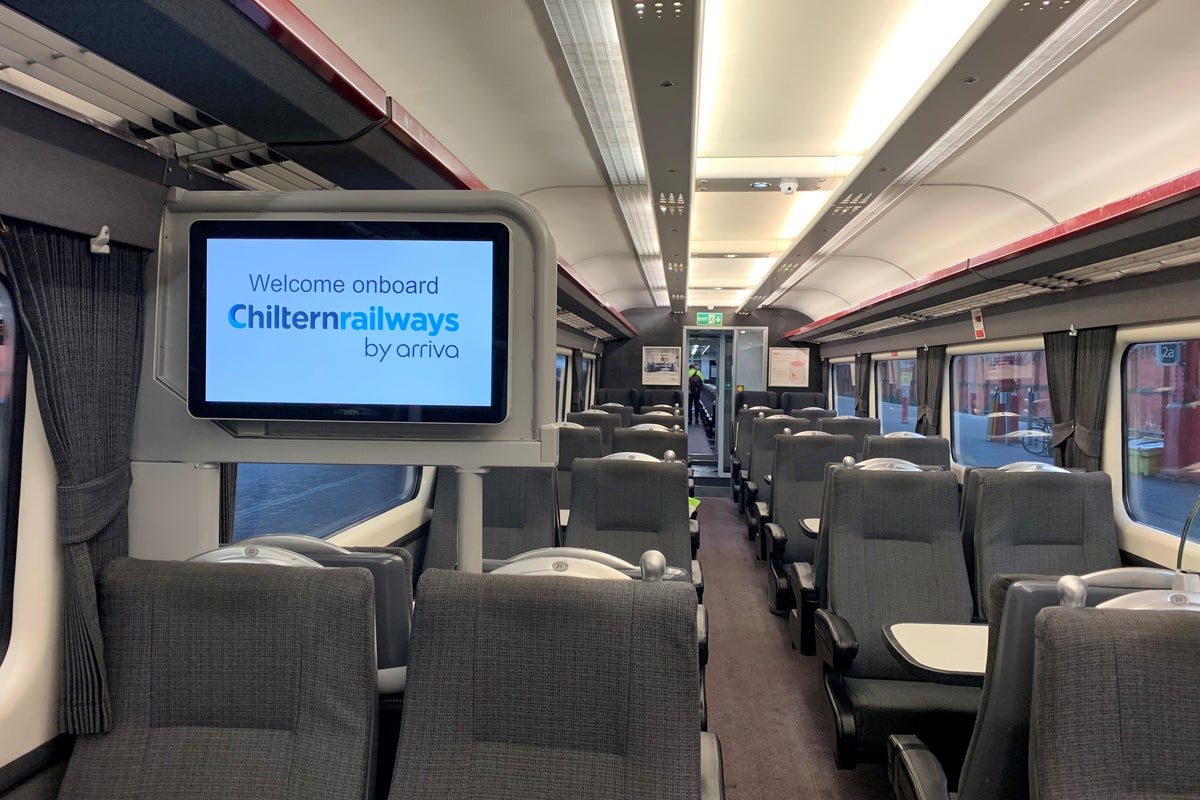
Chiltern Railways’ services became the latest to transition into public ownership on Sunday, marking the sixth train operator to be nationalised by the Government.
The UK’s largest train operator, Govia Thameslink Railway, alongside c2c, Greater Anglia, South Western Railway, and West Midlands Trains, have already been brought into public ownership by the Government.
From December, the Department for Transport (DfT) confirmed that 25 additional daily Chiltern Railways services will be introduced to help tackle “overcrowding”, delivering 10,000 extra seats during each weekday. This plan incorporates half-hourly weekday trains running along the Chiltern main line between London and Birmingham, as well as an increase in weekend journeys.
This December it’s Great Western Rail! Literally anything would be an improvement over what rail’s been since COVID!
Funny you should bring that up, as that’s why the railways were effectively nationalised in 2020. This is the paperwork phase.
Fantastic, may the paperwork phase bring through some nice improvements!
Fuckin good
Just got back from Cordoba, Spain, a journey of 1800km. The first 1700km took 6 hours on a combination of Spainish light rail, high speed rail and a flight. The remaining 100km took 5 hours on a combination of three British trains, with a total of 3.5 hours of delays.
Our trains are now easily the worst and most expensive trains I have travelled on anywhere in the world.
Our trains are now easily the worst and most expensive trains I have travelled on anywhere in the world.
Amtrak has entered the chat.
Partner and I took Amtrak from Seattle to San Diego (roughly 2,000km apart)
The Amtrak trip took over 40hours and was easily 5x the price of flying.
I strongly support trains and travel options aside from driving and flying but goddamn has the US implemented rail travel in the worst way.
This was a while back, over a decade ago and I’d love to hear if its improved any.)
All told, the views of the west coast were spectacular and relaxing but still not enough to make up for the time/cost.
It hasn’t. As a method of commuting or travel to get somewhere it’s terrible. As a relaxing journey where the destination isn’t the point, it’s rather nice… assuming you have a room. And can afford it.
I took the train from Seattle to Philly via Chicago, and it was a really great trip. The food on the Empire Builder was actually good and included, and the observation car was the perfect place to hang out, play cards, and just watch the scenery go by.
You should visit Germany then… I’m willing to bet our DB train service is worse!
bro, you have double decker trains.
I have taken the train in many countries, and Germany was one of the weirdest experiences because I expected deutsche Gründlichkeit and got one of the shittiest ticketing machines imaginable, then boarded a train after over an hour of waiting because all trains were delayed, but was told off for having the wrong ticket because it was a direct train and I bought a ticket for the snail train, which I didn’t know was a thing. The train stations were clean though.
I never understood the complain of DB (and overall German trains), but I only use them once a year. Now for the ticket selling machines… Wtf designed these, they are easily the worst customer experience I’ve ever got on a ticket machine ever! Also the app. Why??
The fucking app is a perfect demonstration of what happens when a company has way too many middle managers who have to justify their existence somehow. So instead of helping to efficiently get people from A to B, they just keep “developing” features for like 0.01% of users.
I regularly use both. British trains are much worse than DB. Thats not to say DB as great, but there is at least a high speed network. The UK has… St Pancras to Folkestone, about 100km. Oh, and large parts of it aren’t high speed at all.
DB is also much clearer about engineering work (of which there is a lot at the moment…), recent experience landing at Stanstead suggest its a pot luck whether there will be a train or a chaotic bus replaceme service. The fractured nature of the British system really doesn’t help - where do I even go to check the status when there are so many operators. Who even operates that line?
Service notices for the whole network can be found at nationalrail.co.uk
Okay, that actually sounds worse. As someone who’s had to put up with DB’s unspeakable delays quite often lately, I wouldn’t have thought it could get any worse.
It just occurred to me that Italia is set to join us soon as another private operator on the prime routes. Hopefully, we won’t have to deal with the same operational chaos as you do (on top of the crumbling infrastructure).
In any case, have a great day (and a smooth trip next time)!
Jeez as a South African looking at our own nationalised train/railway service, called Transnet, all I can say is good luck Britain, really hope you do not follow our footsteps, please learn from us. Luckily thanks to all it’s failures the government has started privatisation of certain parts with amazing success, similar to our Nationalised electricity provider Eskom being forced to allow private generation into the grid. Hopefully Britain has systems in place to ensure there isn’t anything like corruption that loots funds through connected businesses or putting incompetent people loyal to the ruling party in charge as a form of rent seeking.
Good luck Britain, hopefully yours turns out great, like how I am hoping for privatisation to turn our railways around
I thought they were nationalizing the conductor at first.
Don’t worry, this guy is still in charge.

“Dave belongs to -all- of us.”
Much destruction and waste for… nothing. Can everyone agree that neoliberalism was a grift that now needs to end? (I already see one commenter defending it as something else.) I don’t live in the U.K., but I’ve heard of councils turning streetlights off and reducing their services because they have ‘no money’. From the outside looking in it looks bleak.
I just received a meeting invitation from my local council, we are forecast to be over budget by £23 million each year for the next 4 years and they want public opinion on where we can cut. Fucking nowhere! My fault for being more northern than the PM I guess
But think about all the business people we enriched! That was really worth it imo. /s
but I’ve heard of councils turning streetlights off and reducing their services because they have ‘no money’. From the outside looking in it looks bleak.
Reducing light pollution is a positive thing.
Despite all the problems caused by privatisation generally, Chiltern Railways are considered to be one of the success stories. Turning round a failing line into a more reliable and higher frequency service.
Let’s hope GBR can continue to build on these improvements.
I’m a progressive but i am open to privatisation where it makes sense. The privatisation of public transit in UK seem to be successful. I’m in Ireland and the public transport here is shocking so I look to UK and I think it might not be a bad idea to privatise some routes. That being said, there is a fear of private transport companies cancelling unprofitable routes, especially in rural areas. Which in that case, the publicly funded buses or rails should remain servicing isolated areas.
Privatisation was a disaster for buses, particularly in rural communities. It was a huge error in almost all cases for rail.
Personally i think privatisation only truly works if actual competition can be had. But with trains in particular it’s not like someone can start up a new company and have a competing line in the same place as an already existing one.
There are examples of successful competition from new operators in the UK. Eg Lumo offering a direct LNER competitor from Scotland to London, generally for cheaper tickets than LNER too.
Hull Trains restarted direct trains from Hull to London and also compete with LNER.
Grand Central started a bunch of routes in the north to London and aren’t, mostly, directly competing with LNER but run routes that previously required a connection.
The other two open access operators are Heathrow Express, and Eurostar.
Eurostar will soon face competition from Virgin Trains after space at the depot was allocated to them.
Companies frequently try to launch these services but it’s up to the Office of Rail and Road as to which get approved. They all have to run without subsidies, and none of them are being nationalised. They’ll continue to run the same as today, in the same was freight services will.
Rails are public and each company pays for the ability to send trains through them. I thonk that’s how Spain works.
I’m sure that “certain people” got very rich in those 30 years, which was the actual goal.
Ah yes, “those expressing ideologies other than mine don’t actually believe them”
You sure you commented in the right place? In the context of comment you replied to your comment makes no sense.
OP thinks that the actual goal of privatisation was not ideological, but grift. Nobody ever has any evidence for this kind of assertion - it’s always a combination of:
- The outcome of purposeful corruption would also have been to do whatever it is (in this case, make certain investors a lot of money)
- I find right-wing ideology so unappealing I can’t imagine people (maybe just smart people) honestly holding to it.
It’s so bizarre. Thatcher and her party were ideologues and all the evidence points that way. The whole position that enriching private investors was “the actual goal” is based on a lack of imagination around people holding different viewpoints.
In the case of privatisation in the UK, there was a long precedent with much ink spilled on the subject, but people like the OP discount it because they believe so strongly that anyone in power would be able to foresee the outcome, agree that the outcome was bad, and hence the only explanation was corruption.
OP thinks that the actual goal of privatisation was not ideological, but grift
You’re right, it’s a combination of both.
Not everyone is in on the grift, but they still need popular support so they convince the lowest common denominator that it’s good for them somehow.
I think privatisation now is a lot more likely to involve grift than privatisation then. Back then, theoretical arguments about privatisation held more weight, and people had not developed convincing yet acceptable ways to funnel money into private hands. Now we know that privatisation has caused a lot of problems, and a lot of people touting it have much closer links with people who stand to benefit.
My country privatized electricity suppliers almost 30 years ago (coincidentally the same time period the UK train companies got privatized… hmm…) with the argument that the choice of supplier would mean competition would drive down prices.
HAHAHAHA psyche. Prices have never climbed as fast as right after that move and they’ve never come back down (and never will).
OK?
I am not seeing any contradiction here. Yes they were ideologues. And the purpose of their ideology was exactly to enrich private investors.
No, their ideology was that state-run enterprises are less efficient than equivalent private ones, and that allowing and encouraging ordinary citizens to invest in those newly-private businesses (I’m not sure if this was done for the sale of the railways, but it was for previous privatisations) would enrich those ordinary citizens.
This was the defining economic debate of the late 20th century. Many people in these parts dismiss it out of hand.
I’m very glad that British railways are coming back into public ownership, yet somehow am able to acknowledge that in some respects privatisation was a success. The idea that the only, or the best explanation for privatisation was grift is unsustainable.
No, their ideology was that state-run enterprises are less efficient than equivalent private ones
I dunno this seems like madness to me. Any private profit is, essentially, waste. Efficiency gains by, like, not supporting the entire public are also not real efficiency gains.
If a public service is running badly, the appropriate solution is to look into why, not let some rich people become richer off of it.
I don’t agree with it, but I don’t at all think it’s mad.
Typical profit margins at companies are under 10%. To me it seems perfectly plausible that changing the incentive structure around how a company is operated would have a way bigger impact than that. (There’s also executive pay which is higher in private companies, but is typically chump change compared to profit).
So you’ve got to put yourself in the shoes of someone who fervently believes that there is a lot of waste in the public sector. That is, despite decades of effort at trying to reduce or eliminate it. And, let’s get one thing out in the open: there is a lot of waste in the public sector. (It just so happens that there is also a lot of waste in the private sector, and generally less waste in the public sector than its detractors say) So if you believe that, chucking 10% profit at shareholders - who in the case of the big, trumpeted privatisations of the Thatcher years - were supposed to be ordinary citizens as shares in British Gas were heavily advertised to the public, and many bought them - seems like a potentially great deal. Not madness at all.
This was part of a major rethink not so much about “how to run individual public services” but “what is the role of the state, and what is it best placed to do?” It was felt that we’d already looked into why public services were running badly, and got to the end of the road.
not let some rich people become richer off of it.
And just to emphasise, the idea of privatisation was not “let some rich people become richer.” It was to sell shares in privatised companies to as many people as possible, and make investors out of all of us. In one way, it worked: millions of people bought shares in British Gas. But it didn’t end up sticking: most people who bought shares later sold them, making some decent money but yielding the longer-term benefits to bigger investors.
“Somebody should make a profit off this because it’s more efficient” and “my cronies should make a profit off this because it helps me” are different, but the distinction is so minor in practice that lots of normal people rightfully don’t give a shit about it.
They are wholly different in desired outcome and motivation.
In the former, the motivation is a better service by allowing profit. In the latter, profit, and its direction to cronies, is the motivation.
People just often feel uncomfortable imagining their political opponents having good intentions.
Quick, hook Thatcher up to a magnet for infinite electricity. She’s spinning so fast we could end climate change.
So much piss on her grave that it’s now a designated protected wetlands, home to birds and animals found nowhere else in the UK. Afraid that we can’t dig her up again. Beautiful place to visit; have a couple of bottles of water before you go.
She would cotton on and stop spinning straightaway
To be fair, not even Thatcher dared attempt rail service privatisation. It was her disciple Major who pushed it through and enthusiastically promoted battling business units on rails in Brussels.
The privatisation of British Rail did indeed begin under Thatcher, though she did so with reluctance due to the obvious need for ongoing subsidy. Sealink and the hotels were the first parts to go in 1984 (at much less than book value).
These were swiftly followed by a laundry company set up for the hotels, an internal ad agency, a travel agency, and the Vale of Rheidol railway which was privatised in 1989.
Aye, but as I wrote, she chickened out of the actual passenger services and Major finished it.
Ah my bad. I thought most of the privatisation over there was under her. Did she do the water and BT or was that him too?
Most of it was. BT was Thatcher. Water was started by her, after chickening out at least once, but finished under Major.