When I went to Econ class, the professor explained that we call it “Free Market Economics” because of four freedoms:
Freedom of entry and exit - participants (buyers, sellers, and prospective such) can enter or exit the market at their leisure, and the market will not change
Freedom of participation - every participant is in the market of their free will and can leave the market without repercussion
Freedom of substitution - every product on a particular market is essentially the same
Freedom of information - every participant has the same information about availability and prices at the same time
The reward is that free markets are efficient: they lead to the lowest prices and greatest exchange of goods. That is the reason we have them.
When the four freedoms are not mandated, the market fails in different ways, and that’s absolutely expected. When information is available to some before it is to others, we get price distortions - that’s where insider trading laws come from.
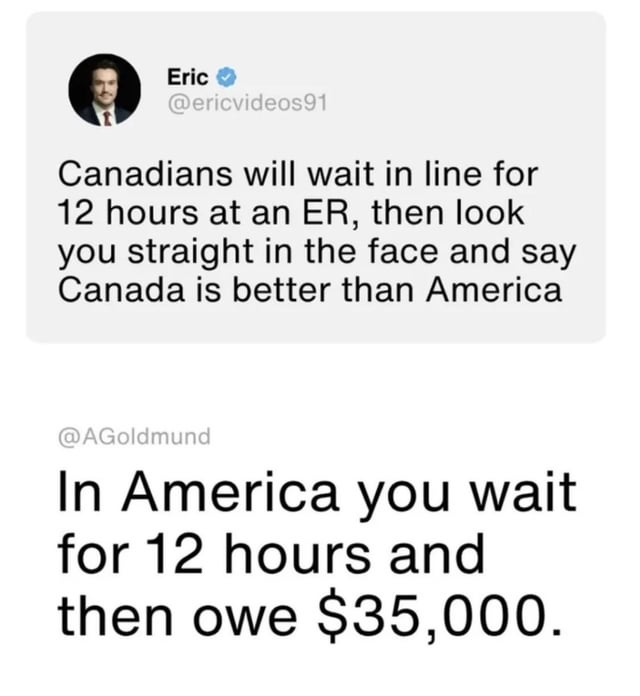
Health care, the prof explained, suffers from the fact there is no freedom of participation. You either buy care or you suffer the potentially deadly consequences. That’s why free markets and health care are fundamentally incompatible: they are expected to be.
I feel like #3 no longer exists for anything in the US economy. You get one product in each niche either owned by 3 companies whose executives all have lunch together (egg farms, ram manufacturers, etc) or where its just absolutely so black boxed its unclear what the product actually is (windows, google, etc)
There’s no freedom of information either. Good luck getting your healthcare provider (your doctor, the hospital) to tell you how much any given procedure will cost in advance.
Healthcare is the literal example of inelastic demand my prof used to teach us the concept. If you die without it, then there is no price where a reasonable actor can choose to stop participating in the market.
Non-fatal health conditions that lots of people put up with. Someone I knew went to ER for first kidney stone, then just endured the pain the second time until they could get a non-emergency appointment, since it’s non-fatal but agonizing, and a non-emergency visit is like 80% cheaper.
Lots of people just accept chronic problems, for example joint pain without seeking medical examination.
Of course, in many cases, hard to make an informed decision on whether it is or is not one of those life or death scenarios in many cases.

When I went to Econ class, the professor explained that we call it “Free Market Economics” because of four freedoms:
The reward is that free markets are efficient: they lead to the lowest prices and greatest exchange of goods. That is the reason we have them.
When the four freedoms are not mandated, the market fails in different ways, and that’s absolutely expected. When information is available to some before it is to others, we get price distortions - that’s where insider trading laws come from.
Health care, the prof explained, suffers from the fact there is no freedom of participation. You either buy care or you suffer the potentially deadly consequences. That’s why free markets and health care are fundamentally incompatible: they are expected to be.
Are free markets efficient? I think that’s an open question.
I feel like #3 no longer exists for anything in the US economy. You get one product in each niche either owned by 3 companies whose executives all have lunch together (egg farms, ram manufacturers, etc) or where its just absolutely so black boxed its unclear what the product actually is (windows, google, etc)
#4 is on the way out too. USA! USA! USA!
That’s why monopolies are supposed to be illegal.
Its also why pricefixing is illegal.
There’s no freedom of information either. Good luck getting your healthcare provider (your doctor, the hospital) to tell you how much any given procedure will cost in advance.
Healthcare is the literal example of inelastic demand my prof used to teach us the concept. If you die without it, then there is no price where a reasonable actor can choose to stop participating in the market.
Well, it’s a little elastic.
Non-fatal health conditions that lots of people put up with. Someone I knew went to ER for first kidney stone, then just endured the pain the second time until they could get a non-emergency appointment, since it’s non-fatal but agonizing, and a non-emergency visit is like 80% cheaper.
Lots of people just accept chronic problems, for example joint pain without seeking medical examination.
Of course, in many cases, hard to make an informed decision on whether it is or is not one of those life or death scenarios in many cases.
#4 Doesn’t seem to be a thing anymore, president seems to get away with all the insider trading he wants PLTR tweets and what not
I believe it’s called inelastic demand: things you don’t stop buying even when prices go up.
See also: housing, food (though you may eat less or eat other foods, but you still need food).