Article about an experiment from Brisbane, Australia.
None wanted to continue what? Driving cars? Continue the trial? I can’t read the article due to a pay wall
Here is an archive link.
Almost a dozen regular Brisbane people took on a challenge to give up their car for 20 days, but by the end of the experiment, they decided it was unrealistic for them to go totally car-free.
Urban planners from The University of Queensland recruited 10 car-owning Brisbane residents – five men and five women.
They were asked to follow their regular schedules, but use public transport, walk or ride instead.
What they found is that the city and it’s public transport options are antagonistic toward people who do not or cannot drove themselves.
The word “antagonistic” implies intent. I generally believe in human incompetence.
As someone who has been without a car for a decade now I’m not sure I could go back. I love walking and biking too much.
My understanding of the study is it is highlighting that without good public infrastructure it is difficult for most people to go car free.
For example, for me, my daily commute is ~20 minutes each way by car. Or ~3+ hours one way by bus, ~5 hours walking, ~90 minutes biking. The closest store to my house is a 20-30 minute bike ride, or hour walk, without sidewalks or bike lanes for most of it, making it rough and dangerous to traverse (Dont get me started on how its an over 1 hour bus ride [yes for a route that takes 40 minutes to walk]) It is its own chiken and the egg, poor infrastructure is justified as not even enough usage but people dont use it because there is not enough non-car infrastructure.
Brisbane is a shit city for cycling. Who is surprised?
“It demonstrates that in low-density, sprawling cities like Brisbane, people cannot be expected to permanently give up driving unless there is significant investment in public transport.”
However, researchers found given participants were likely to slightly reduce their reliance on cars, it showed experiencing car-free living, even briefly, could help people break away from automobility.
In Brisbane, 89 per cent of households own at least one car and 48 per cent of commuters drive to work.
This was essentially the goal of the study, to demonstrate that more investment is needed in public transport to increase public buy-in, and that even just being forced to try it for a few weeks increases usage and lowers car use longer term - so if there can be incentives to try public transport that could also increase its use long term and reduce cars on the road.
The headline is not what people here (myself included) wanna read, but the study succeeded in its demonstration and will hopefully drive positive govt policy outcomes.
will hopefully drive positive govt policy outcomes.
From the current city and state governments? Highly unlikely.
If services aren’t within 5-10 minutes maximum, people will not walk or bike there. That’s often greater than the distance just to get out of some neighborhoods.
If public transportation is not within 5 minutes or so, people will not use it.
The cost of a car can be under 10/day. If public transport is even half that for full day multistop use, people won’t use it.
“However, researchers found given participants were likely to slightly reduce their reliance on cars, it showed experiencing car-free living, even briefly, could help people break away from automobility.”
I think this is an important secondary take away here. Reducing car use is still much better than continuing at current rate. (Similar to eating less meat vs going vegan cold turkey).
Owning a car does come with large sunk-costs tho - so you won’t feel the full financial benefit from just reducing car use (still have to pay rego, insurance, maintenance etc.)20 days isn’t really enough to judge. If you didn’t own a bike at the start of those 20 days, could you really get a bike and all the clothes, safety gear, etc. you need and get used to biking before the end of the experiment? If you’re using public transit, can you really learn the routes and schedules for the places you need to go in just 20 days?
Also, assuming these people all owned cars, they were still essentially paying for their cars the whole time. They might not have paid for gas, and the wear and tear would have been very slightly less, but any car loan they had still had to be repaid on schedule. If they rented a monthly parking pass or something, that would have to be paid. Not only that, but when you don’t own a car, you tend to make different decisions on where to live, and sometimes where to work too. So, they’re living in a place that’s car friendly (and maybe not public transit friendly).
I would bet that if you took someone who didn’t own a car and intentionally lived next to a major transit hub and asked them to get around by car for 20 days, they wouldn’t like it either. They wouldn’t have a place to park at home, rush hour traffic would probably be extremely stressful for someone who didn’t do it every day, and so-on.
What this really needs is something like what you get in one of those “wife swap” TV shows. Someone goes to live in a completely different place with people who live very different lives. Instead of living in the sprawling suburbs and getting around everywhere by car, you now live downtown in a high-rise right near a great public transit location. In addition, calculate how much someone would save without a car, and give that to them as a cash payment every day/week so they understand that positive side of owning a car as well.
You only need special clothes if you are a wanker, everyone else just wears their normal clothes
You need special clothes (full face helmet, kneepads, ripstop breathable clothing) if you ride downhill or enduro. But normal everyday riding you really just need a helmet unless you’re a new rider.
wankers
Yeah, I already covered that
You think someone riding downhill is a wanker? I’m guessing you’ve never tried it if you think that.
This is the gear i’m talking about:

I guess, that was in jest, also anyone can be a wanker if they want to
Yeah twas in jest, I should have put /jk
Wankers is quite harsh
Let them feel sexy on their bike, if they want to
could you really get a bike and all the clothes, safety gear, etc. you need and get used to biking before the end of the experiment
Most people don’t wear special clothes to ride their bikes.


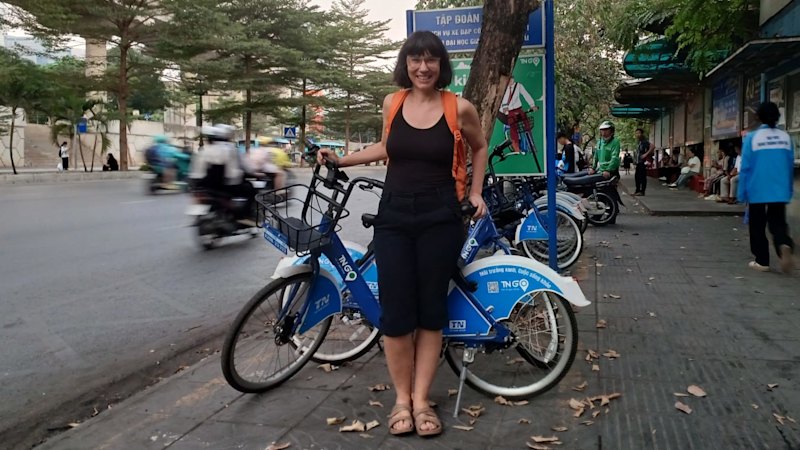
Those aren’t pictures from Brisbane.
In places where biking is well established as a way to get around, people think they don’t need safety gear. But, when a city doesn’t have a lot of bike infrastructure, cars are going to be constantly driving way too close to bikers.
This is an image that’s actually from Brisbane:

Or you could have gone with this one:

From this story: https://www.abc.net.au/news/2020-11-11/many-busy-brisbane-cycling-routes-make-no-allowance-for-riders/12862402
What? I spent years riding a bike. You could literally go buy a bike and 2 minutes out of store. As far as special clothing or anything you don’t need any special clothing. Winter time you wear your winter stuff summertime you wear your summer stuff. That’s about it. You put on a helmet that you buy at the same place you buy your bike at. And that’s all you need to do. You can literally jump online and have it delivered same day as well. And you don’t even have to go anywhere. That’s not the issue in getting a bike and using it for those 20 days.
The same was done in Vienna. People did not use their car for 3 months.
Results
- 2/3 could imagine living without a car
- 25% have sold or are planning to sell their car
Considering it was founded, like, 2000 years ago, that isn’t really surprising. Turns out, being a pedestrian in a city which was established in a millennium when being a pedestrian was the norm is quite easy compared to the same effort in much more recent municipalities. Have you ever really paid attention to the plot of Who Framed Roger Rabbit?
Fair point. We even maintained our 2000 year old skyscrapers here.

But you forget, that we’re living in forest cities with exploding trees!
That this idiot even got a single vote is beyond me…but well, who am I to talk with Kickl promoting the same kind of xenophobia.
But I’m getting a bit off topic, although all those conversatives world wide seem to love to be stuck in their cars in traffic jams…
Vienna is very walkable but also really big. The answer is, mostly, public transport, a lot of it and cheap. Public transport costs ~ 400€ per year if you have the annual pass for Vienna (you can use all public transport). Also at the moment a build out of bike lanes makes a combination of bike/public transport very interesting for big parts of the city.
P.s. Can’t really remember the plot if Rodger Rabbit.
The villain of WFRR was dismantling the trolley system in order to force people to buy cars and use the freeway system.
Los Angeles was founded in 1781. They didn’t have cars then.
Then how did they get on the 10?
Same way they do now. You just don’t.
Spotted the American.
You have very little understanding about city development and planning. Otherwise you’d know that most of the transport corridors that are in use today were started in the Industrialisation period when trams were introduced.
A city with millions of inhabitants can’t be explained by looking at the small population in the centre.
Vienna has an amazingly good and inexpensive public transport system and quite good bike routes combined with fairly inexpensive housing due to good city governance over several decades (social democratic party by and large).
The difference between most North American and European cities in terms of availabke transport choices is not what happened hundreds of years ago, but what city planners did in the post war period (50s to 70s).
It’s not too late however, if you look at the incredible progress Paris had in the past 5 years.
The framework was still established long before cars, which was then easier to expand upon. Absolutely governance has a huge effect, but more modern cities were developed with cars in mind, with endless suburban sprawl. It’s far easier to implement public transportation in places that were originally built around walkable city centers.
Additionally, places that weren’t bombed to hell in WWII didn’t have the opportunity to redesign for public transit mid-century. They grew with car-centric infrastructure and never reset. I’m not saying we shouldn’t develop public transit, we absolutely should, I’m just saying it’s harder to implement with existing infrastructure and layout that spread everything out over dozens of miles.
Vienna is a dream for public transit. Didn’t get to use the cycle routes but it seemed I was never far away from any transit. Beautiful city to boot.
Yes we get it it colonists living on stolen land have all the room in the world to be able to vroemvroem their fatass everywhere
After World War 2, the Netherlands was bombed to shit, and they rebuilt their cities For The Car! Then in the 90s they realised cars suck, and they started rebuilding their cities for people. Now it’s the best country in the world to drive a car, because there are so few cars on the road.
The moral is, Europe isn’t winning at urbanism because their cities are old, they’re winning because they’re trying hard. Brisbane isn’t trying hard.
This didnt start in the 90’s, but in the 60’s
Also, the Netherlands wasn’t bombed to shit. There was some bombing here and there with low to moderate damage. Only Rotterdam was pretty much levelled just to make the point during the invasion (and because of a number of other stupid reasons)
The point though is that, yes, the Netherlands decided that levelling Amsterdam to make it a giant car parking lot was a bad idea and they went full bicycle. And yes, its been the best decision ever.
Having said that, i live in Vancouver now and they’ve made some great strides in improving the city for bicycles. If Vancouver can do so, a y other city can do so too…it’s just a matter of wanting
In the Netherlands, this change caused a huge change in architecture as well, because when you restrict cars and push bicycles, you start also making local communities better, making sure that there are smaller local stores, bars, restaurants, within each community, at walking on cycling distances. It has transformed the country over these decades.
Here in American continent countries this can work too, even though the architecture has been messed up so badly because of so many decades of car brain designs. It will take decades to undo the damage, but it can be done
The only necessary ingredient is the will
The best country to drive in? Hmm. It’s just as busy as the surrounding countries and traffic speeds off the major roads are painfully low. The standards of driving are surprisingly poor, at least compared to neighbouring Germany. It is very well set up for car alternatives and I really enjoy going car free on my visits there, but there are many countries that are more enjoyable for driving.
There’s about 4 million people in Brisbane-Gold Coast, 10 is not very representative…
You’d be able to get to work. If you have kids younger than high-school age, or if anyone in the house plays a sport, you have zero chance.
Not once have I seen someone taking a train to footy or cricket practice.
You don’t live in a place with good public transit though, so of course you haven’t
If you haven’t seen it, it can’t exist
Yes you need your fatzomover
Poor kids going to football practice having to carry a grand total of some clothes to change into, completely unthinkable to take transit/bike to the field
Jesus christ what a joke of a comment
Yes, footballers are generally a bunch of softcocks. I live next to a footy oval. 100% cars. Mostly monster trucks. It’s a 10 minute walk from the train station.
Spectators will watch from their cars. They don’t even walk to the fence. Every parent is overweight. None of them actually play.
Some of the cars come from houses so close that I can see them leave the park and pull into their driveway.
The system is rigged. If you’re dependent on the bus in a city where everything is miles apart, the buses run every hour and only daytime hours, of course it’s going to suck.
I remember in Australia, trying to meet my friends in the city center. I had a bus scheduled every hour, sometimes it didn’t come though, so I could be waiting over an hour for the bus to take me to the nearest train station. The train was every forty minutes, so it would easily take me two hours to get there. Then I had to hope they showed up too.
I later found I could bike and it would take about an hour.
Ask 10 people in Amsterdam and half would tell you they already haven’t used a car in weeks. The only ones who’d have a problem with it are those who work far away from Amsterdam.
I was amazed by the transformation in Amsterdam when I visited last summer. I’ve been visiting Netherlands for 40 years and always admired their cycling culture but lately they seemed to have almost eliminated cars from the city. As a result it is incredibly quiet, serene and there is no vehicle soot on the buildings, as is the case in London. I could often choose among many different modes of alternative transport in any given location.
The English solution to this problem is ever more stringent penalties on the driver (e.g. ULEZ) which may be profitable but they have been ineffective at reducing the volume of vehicular traffic, pollution, accidents, ad nauseum. We pay a huge price for car culture.
and fat people in Amsterdam are rare, coincidence?
I lived in Amsterdam for 10 years and only got a car when I married someone who lived in the suburbs. Well, actually I still don’t own a car but I can borrow one as needed!
That’ll be 1.5M€ for a 40m² apartment thanks.
Because they’re fat and lazy
Much like your head. Read the damn article.
I think this small experiment simply demonstrates that ditching cars is not a natter of personal preferences, but a community effort
And a matter of traffic design. You can design places to require a car for everything, or you can design them with bike paths everywhere and a good public transit system.
I’ve had 2 catalytic converters stolen now. Its just not worth the hassle to have more costly maintenance on a machine that already requires regular costly maintenance
It depends on where you live. I wouldn’t be able to get around without my whip.