

4·
14 days agoAnd they are fake flowers.
And they are fake flowers.
After four fall-offs, the process usually comes to a halt on its own?
Wine consultant Leon Deans said distillation could be a viable option to remove the oversupply, but may require government support because the cost of distilling the wine could be higher than the revenue from the ethanol.
If you consider that:
This seems like it’s a net energy negative process where the total amount of energy available to the society drops where you do this. This is exactly why it loses money.
Basically:
This cuts wine makers in on the deal in a way where the market makes this feasible despite the underlying thermodynamic losses.
NOTE: the grapes and wine that were originally grown, the harvesting, bottling etc also have thermodynamic and material costs that are totally external to this analysis. The farm itself bought fuel when it made the wine, that’s all not ibcluddd into the ethanol calculus. When you consider the total investment with a wider boundary you can start to cost many additional resources like time, water, wages, insurance, financial interest and on and on.
He called Trump the anti-Christ and evil.
This comes from a recent interview you can listen to here or read here.
The absolutely most interesting thing from this interview is not the hash smoking detail.
The part that is more important is that Carlson states early on in the interview that he feels that the American president was being blackmailed by Israel into engaging in the Iran war. Carlson basically comes out and implies that the president is compromised and manipulated and knows it, and he had no choice. He doesn’t specifically speculate on how they are controlling Trump. But he says that he’s shocked at the media failure to investigate this. Its really worth listening to this section of the interview. He met Trump 3X and deeply discussed Iran in the weeks before the fighting.
The only thing that comes immediately to mind is that Israel has the Epstein files and are threatening to release them. But it could be something else of course.
If shit properly hits the fan, I suspect things are going to be way more desperate.
To be a little more precise, people have studied this question carefully at a planetary scale.
The total agricultural production possible in the absense of artificial inputs like fertilizers, pesticides, diesel tractors, cold storage and refrigerated supply chains etc is around no more than 3billion people running off solar inputs and natures nutrient cycles and the amount of land and water available.
Pretty shocking number if you don’t have the context, but here is a place to get started on the information this is based on.
So for example, in the green revolution, land and agriculture technology increased a modest amount, but artificial fossil inputs into the existing technology system increased 90-fold. Most of the gains in food production are because it’s now based on fossil energy and nutrients rather than natural sources.
Currently, today ~40% of all the human food supply molecules come from fossil fuels and are incorporated into the plants and animals we eat.
So it’s not “just” a land management issue, or urbanization. Humanity is literally on artificial life support. There is no simple, survivable way out of this commitment. Fundamentally this is far, far from penciling out any other way we know how to survive. Humanity population passed some threshold for change around 3-4 generations ago.
In the collapse community people have been aware of a “thermodynamic” collapse of energy supplies for quite a while.
So for example, to mainstream people and the investors, there is something called ‘oil’ which seems like a commodity item.
In the collapse community, worldwide supplies of diesel and heavy oil energy products (shipping, trucking, agriculture, mining and gasoline refining among many other applications) has been in a 10-year long period of decline with major implications for our global civilization.
(Diesel / heavy crude comes from several places globally. The USA has run out but Venezuela and Iran are two heavy hitters for the molecules needed.)
The blockade on the strait is only having any impact because it’s a zero sum game now that nobody can raise production any higher. Like you don’t see Norway and Canada suddenly ramping up and filling demand, right?
I consider this the most parsimonious and cogent world view.
In a short summary: the blockade is an artificial shortage that is designed to collapse and bankrupt the most dependent and vulnerable nations in the global periphery, which is a “triage” that preserves oil supplies for the wealthy nations in the long run. Like this triggers collapse, and then as a second order effect global demand will fall for energy which is in an irreversible depletion event. This is the only way the most developed nations extend their existence through the crash.
This is all an open secret, you can dig into technical papers and agency reports and academic publications, everything will say the same thing. However, this is not really a “mainstream” consciousness.

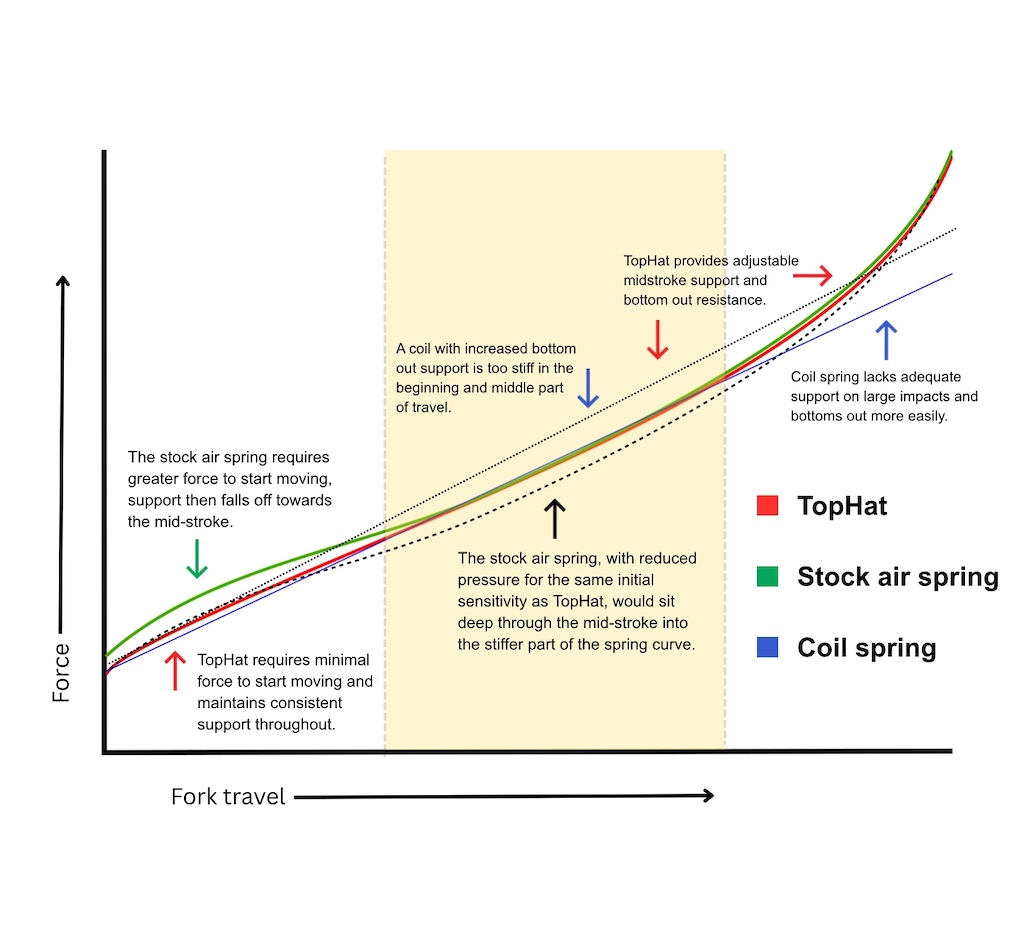
Take a close look at this graph here.
As you can clearly see, the main effect of this modification is in the curve of the initial part of the fork travel.
Cool, huh?
Now, consider where your fork would be in the travel once dynamically sagged during a ride (usually around 20-25% of travel is gone when you just weight the bike, actually positive motion ride characteristics are only the last 2/3 of stroke.)
It appears that this actually doesn’t truly do anything at all. The fork performs the same unless you unweight the fork and move it negatively below sag position. All the subjective ride impressions are just placebo effect.
I just tried searching for an enduro bike and it didn’t really work. It recommended two all mountain bikes and an XC race bike. All three bikes were in the same brand and it is a brand I’d never ever consider buying.
It would be interesting and useful if you could filter in other ways also. Like frame material, suspension design or a specific geometry or characteristic (such as anti-squat %, stack height,frame stiffness, etc).
Ok, I have a point to make about how weird mountain bikes are.
Think about cars, motorcycles etc. They all have same or more travel on the front than the rear. This is always the case with moving vehicles.
Now choose a modern mountain bike. An enduro bike in a lot of brands will be stock 165 rear, 170 front. At a glance this seems ok on paper.
My criticism:
165 is the actual wheel travel of the rear wheel. (Nobody cares about the 65mm stroke number.)
170 is the telescoping front travel, like the shaft stroke of the fork leg. But keep in mind, that’s not vertical travel, that’s moving on an angle (around 62-65° to start). Decomposing the vertical component of the motion, its around 150mm of vertical travel. (Remember trigonometry?)
So a brand new enduro bike will move the front wheel 150mm, and the rear end 165. You can definitely FEEL this riding. Speaking of myself, it’s completely weird and ridiculous feeling going down the trail on a bike like this. It makes you ride very strangely in hoe you have to compensate with body position.
On my bikes I always bump the front travel to be the same (at least) as the rear (which gains even more from considering static sag % 30 rear / 20 front). Which means doing trigonometry when I spec the build… Because bikes are labelled in this irrelevant method.
Anyhow, how did this whole arrangement come to be seen as somehow normal? Like all these brands do this, it’s a common industry practice to produce bikes with smaller front than rear travel but to use wacky nomenclature that obscures this.
( * Have any of you ever ridden bikes with any bicycle brand product managers? It is eye opening to say the least.)
168 rear, 180 front.
I think all mountain bikes should have more travel and better suspension designs.
You know all the common designs are now so old their patents have already expired? (VPP, DW-Link, Mac strut etc). Bikes are stuck in a very strange design dead end for over 20 years. I think suspension quality is the current weakest aspect of bikes.
I consider the race results of a company like Frameworks to be a solid exemplar of what you’re suggesting.
All these multi decade bike brand behemoths got their lunch stolen by a single poor guy with a better idea.
They were so butthurt they went through the UCI and made such a startup company illegal in future world cups.
Do you pay attention to what’s going on? Literally yes, you or I or anyone can design a better product. These guys are resting on 20 year old ideas and keeping technical development stagnant. This has now been proven beyond any doubt. You don’t get small companies banned from the world cup if you’re confident in the competitive strength of your engineering!
The amount of engineering and development and marketing that goes into a 15K pro race bike is where the cost is.
For $15K, they should be better engineered. Think of the amount of engineering that goes into making a moto… It has to pass safety standards, meet all kinds of regulations and perform as expected.
Mountain bike engineering is a total joke in comparison.
Who designs the suspension kinematics for Pivot? Don’t they hire Dave Weagle for that? According to this page, they just have a few proprietary patents that are basically some static frame hardware. https://www.pivotcycles.com.au/technology/patents-and-proprietary-designs/
I wouldn’t argue against this, but basically most bike companies are really slapping commodity parts/components on frames that they outsource the manufacturing on. The basically are just designing custom label products that they get made by large factories that handle many competing brand’s orders. Often the companies don’t even own their own fixtures or do all their own engineering.
At current boutique prices in the Direct To Consumer model, you can have $1M gross revenue selling 200 bikes a year, which is like a mid-size bike shop volume of annual sales. This is very low volume.
When I worked in the bike shop, we used to joke that when the bike rack has mor value in the vehicle above the rack than the vehicle on the bottom, you have the right priorities.
But its absurd when you think of the precision and standards that go into the manufacture of each…
This conversation has been going on for a while, and people have all these cliché justifications for the high price of mountain bikes ‘they are lighter’, ‘the global market for motos has higher economies of scale’ etc.
End of the day I think its a “hobby tax” that bike riders have been justifying in terms of “a price the market will bear”.
A friend of mine who was working for a bike brand told me (this was a few years ago) that the company paid about $75-200 wholesale cost for a welded alloy frame and they could sell these for $2500.
I mean, that is fine, but now explain why bike companies are slow to return an email, have sloppy customer service, battle customers on warranty’s and don’t support 3 year old designs and have no spare parts. Like, how are they not providing red carpet service while charging luxury market markups? Infuriating.
Companies are super secretive on warranty and frame failure rates, but I’ve heard that a lot of modern bikes fail about 10X as much as they used to. They have shaved so many grams the products just don’t last.
I also think there is a lot of cultural and technology stagnation going on, new models and new versions never excite me as a rider. I cant figure out why I want a new bike, what’s the benefit?



I think he said RENOUNCE victory?