I skimmed the comments and didn’t catch this, but don’t forget about all the PRIVATE EQUITIES buying up nursing home facilities, banking on SSI, Medicare and Medicaid funding, upcharging perscriptions, “maximizing efficiencies” (aka paying as little wages as possible), and the revolving door of customers…
Don’t forget those private equities buying up life insurance companies that are being used for dumping grounds for bad loans that’ll be bailed out through state-based guaranty funds instead of passing through bankruptcy. In other words, these private equities are using life insurance subsidiaries to offload the risk of bad loans (mostly AI-related) to taxpayers if those life insurance companies become insolvent, which will likely happen when the AI bubble pops.
The solution is this: every sector of the economy has been optimized to extract as much money from everyone as possible. This is the implicit role of government–to help the rich get richer making money off of other people. Have an idea that makes money? The government will help you make it happen.
This through-and-through corruption means that people now graduate in lifelong debt, working jobs that don’t cover the rent of places they can never own and spend money on health insurance they can never use because they can’t afford the co-pays and they are forced to buy an expensive car because that’s the only way to finance because the busroutes have all been purchased by car companies and liquidated long ago. Forced to work longer hours and with less money in our pockets, our third spaces disappear. Now stuck at home, we are forced to buy electronics at inflated prices because of the AI bubble and use oligopoly internet that should have long ago been regulated as a monopoly but for the massive campaign contributions those companies made to politicians.And our food is more expensive because it is controlled by a few companies.
We are no longer citizens. We are livestock.
This is unsustainable.
This is not the explicit role of government in a functional social democracy. Which the USA obviously are not.
It’s about money. But a nice side effect is that it keeps the people busy so they have little down time to reflect on why they are in that condition, or more importantly, no time left to take action, as well as the threat that if they do anything, it could endanger their job and life. That’s why they don’t take away too much from too many, otherwise suddenly those masses don’t have anything to threaten and a lot of free time to notice what happened and by whom. Bread and circuses.
100%, The New Deal in the USA was largely a result of the fear of a communist revoltuion during the Great Depression.
so what would be your first act as president
After that speech, I guess I’d start trust-busting, but that’s presuming just being president would give me that power.
That’s a pretty good summary of the situation, but it’s the problem, not the solution.
Sooner or later, something’s gotta bend or it’ll break. The oligarchs know this, and that’s why they’re putting so much effort into pacifying with false promises while tightening surveillance and control. They hope to starve us out or put us down before we reach our breaking point. They want us broken and weak long before it comes to that.
And honestly, the level of technology and the global hegemony of the capitalist order present us with a situation that’s never been seen before. The level of control and the efficiency of the surveillance state, the impersonal nature of automated weapons, makes for more than just an uphill battle. Calling ordinary people the underdogs is an overstatement of the hope we have.
And with more and more tyrants in the world learning what they can get away with, and the so-called “free world” opting for passivism and appeasement while handling their own internal threats with kiddie gloves and being more or less complicit with the plutocratic interests behind it all, it seems there’s very little hope this time for outside intervention saving us either.
So much rests on these midterms coming up. I hope they happen fairly and without too much ratfucking, I hope the people come out in droves to punish the fascists for what they’re doing to our democracy, and I hope the results of the election are duly acknowledged and the peaceful transfer of power happens smoothly. I hope enough people of good will make it into the next congress to successfully put a halt to the fascist agenda and block them from ratfucking our elections even worse, and I hope in two years we elect somebody who will restore our institutions and see justice done to those who have been dismantling it.
I don’t believe it’s too late for the world to make a comeback, but so much rests on these upcoming elections. Doomsayers will come out of the woodworks to try to discourage us from voting. We cannot listen to them.
The U.S. is an open air prison
Open-air farm.
Same with universities and overworked, underpaid professors without tenure.
I’ll never understand the economy. To me it’s just imaginary money. I did understand some parts of it thanks to the explained with bananas videos by Primate economics but that’s about it.
The ‘I just don’t understand’ shit pisses me off so much.
Corporate greed pal. No one tell Luigi
You can’t wrap your head around the economy being a wealth extraction system Masquerading as a functional society?
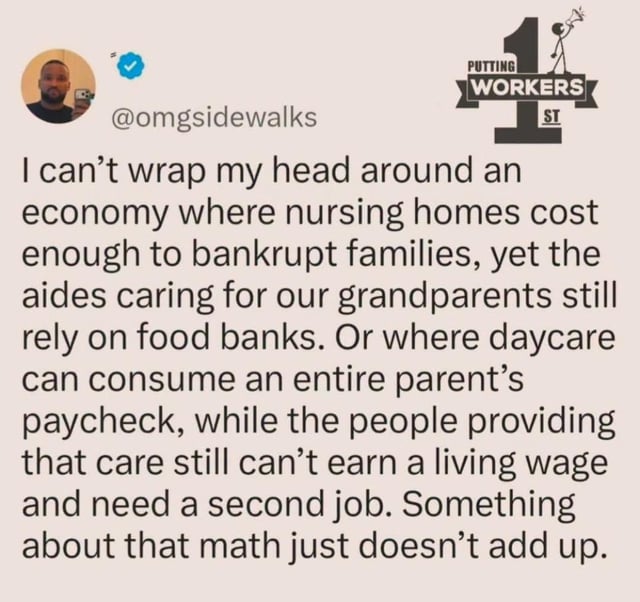
First, there is corporate gouging. Anyone owning stocks wants to see a return, not a moderate one but a big one, on their investment. Second, it isn’t a straight one to one employee to patient ratio. 24 hour care is 8760 hours per year and full time work is 2000 (with 2 weeks paid vacation) meaning 4.38 employee years for 24hrs, 365 days. It isn’t quite that much because staffing is never 1:1. If it were 1:1, at $20 per hour paid to the caregiver, with vacation, sick days, health care, CPP, EI, WCB, it is a minimum of $58,000 per employee. That alone would work out to $4800 per month without housing, food, cleaning, equipment. It isn’t cheap to house people who cannot live independently. We need a different model for care to keep the costs lower while providing care that is necessary. This used to all be “free” in-home by older women (Boomer, Silent Gen, Greatest Gen) and still often is, if they cannot access care for family members. Much like child care, that again women used to do for 'free", it costs real money to have someone else cover that work.
The USA is just 3 Corporations in a trench coat. And corporations are just pyramid schemes.
People will lose their minds if you suggest giving someone medical care for free, but they keep ignoring all the landlords and CEOs and private equity groups and all the middlemen extracting the vast majority of all the wealth out, while also contributing the absolute least.
The fact that we have a system where one person works every waking minute of their life and still can’t afford basic food and housing and another person sits around all day on their 3rd yacht sipping one of a kind wines and rakes in billions is insanity.
Truly, Land of the Free (to exploit).
I hope Washington is enjoying the show.
He fought to keep America the way it was. Ya he was part of the problem.
Middleman economy.
The American dream:
Do no work, Create no product, Have no ideas, Take a ever growing cut on everything in life.
A leech provides value to a ecosystem, the same cannot be said for landed lords and lender lords.
What’s the cost difference between this and hiring rotating shifts of nurses anyway? I know the equipment wouldn’t be there but yeah
A lot of people need more care than just a nurse, they need meds and to be monitored and medical aids or devices, like special beds or lifts. Inpatient care was also subsidized previously
Also the social aspect is pretty significant
Long-term direct care for humans at any stage of life in the US (that aren’t of extreme wealth) is both obscenely expensive and yet woefully inadequate. I work in brain and spinal rehab AFCs and we’re far worse than most average nursing homes.
The rent is super expensive, that’s the answer
Oversimplifying but I think it’s worth thinking about an angle I haven’t seen here yet:
People to tend to trust Big Corporate care-givers and distrust private individual caregivers.
There are of course Good Reasons for this (Who do you sue if they hurt your loved one? Who licenses and trains them?), but among the Bad Reasons are: People just inherently trust a big name they’ve heard of before, especially if that big name has similarly gargantuan PR and legal departments who scrub any bad press away.
In other words, you could hire your neighbor to take care of your kids all day, but most people choose not to, and instead send much more money towards big businesses with massive overhead costs because people trust So And So National Healthcare more than Jane Doe.
True. I have been catching myself trusting big and familiar name over something new for years now. And then I remember that the bigger the name, the more their interests are against mine, and things become way trickier
Yeah, the bigger the company, the more your money goes to their overhead rather than the product or service itself.
The smaller, the smaller their pockets when it comes time to sue for something they did wrong.
Pros and Cons, like most things.