

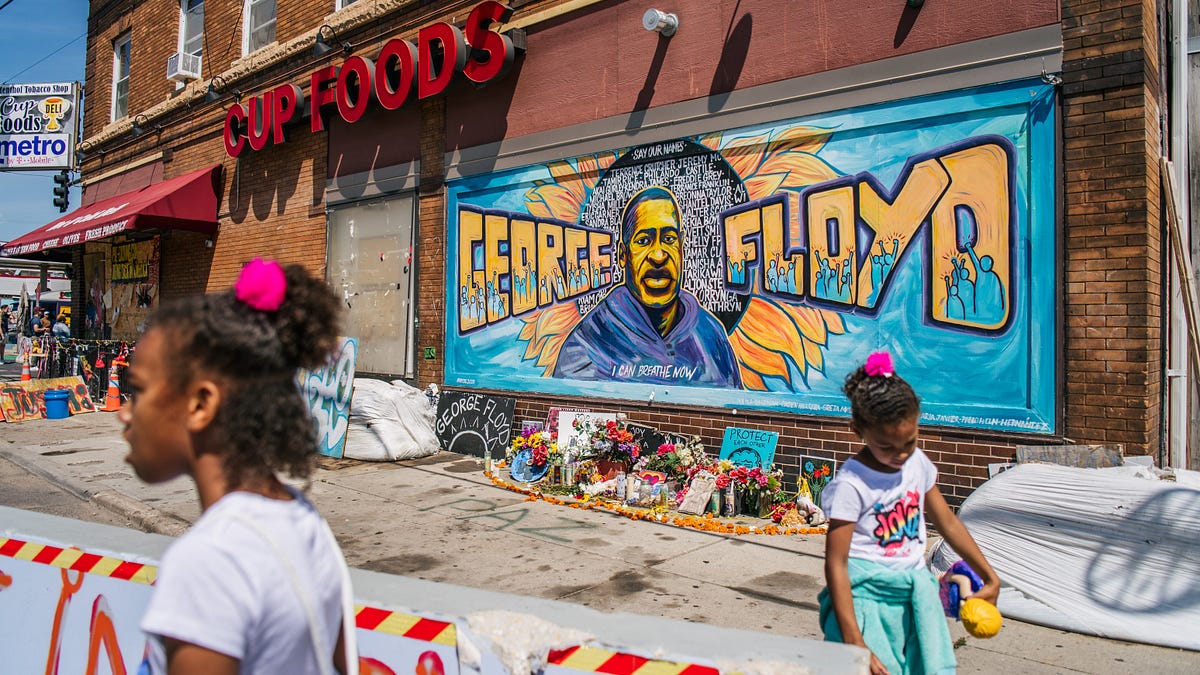
Your book, like Elizabeth Hinton’s “America on Fire,” delves into a decades-long cycle that’s played out in many US cities: Police violence, followed by uprisings, followed by promises for reform and blue ribbon commissions that ultimately produce only “modest change and a photo op.” Did you come out of your reporting with a solid idea of what a better process would look like?
Ellis: I don’t know how you can look at Minneapolis today and say they are better for choosing reform over revolution. The mayor reorganized the public safety department, then there was turnover in the leadership there. The chief who was supposed to lead the transformation of the police force recently resigned in disgrace. Like most police departments in the country, the budget continues to balloon thanks to overtime costs. And at the moment the city is failing to even meet the basics of its court-mandated reforms. By definition this is insanity, right?
I think like anything in local government, having a process for the community to guide designs and offer feedback is important. But I think the starting point has to be a total tear down, not a rebuild. That sounds simplistic, but look at where making changes on the edges has gotten us? Revised training standards and use of force policies have amounted to departments that are effectively the same. The aim needs to be so much higher.
The Anarchists lost to the pro-Nazis government, idk why everyone tries to use that as an example. Really depressing to think about.
There are really only two large scale examples of revolution ending in a democracy: France and USA.
In the case of the USA it led to a lot of genocide of natives but you could argue the crown would have eventually done the same.
The way I see it is if reform is an option: take it. If reform is not an option then, and only then, will violent revolution have a chance at resulting in a better or equal system.
There’s a really fantastic 6-part documentary that goes over the conflict in great detail, but to give the short version:
It failed for a multitude of reasons, but when I did my own deep dive on this, Anarchism itself wasn’t one of those reasons. I found that the specific time it took place, as well as the previous industrial capacity of Spain itself, were likely two of the biggest contributors.
The civil war occurred during a period when there were powerful states on the world stage, Nazi Germany and Fascist Italy, who were ready and willing to supply needed logistics and manpower to other right-wing states. It also happened when both of those states were not yet embroiled in their own world war, giving them the opportunity to send more resources and aid than they would’ve have been able to justify a handful of years later.
On the other hand, the Anarchists (and Liberals) of Spain had no allies on the world stage willing to help them besides some meager aid from Mexico (who lacked the ability to send airplanes or tanks), and a few secret shipments of aid from France. The USSR ended up sending the most weaponry, but only to the Marxist-Leninist faction so they could control the country if they won, and those same marxist leninists targeted the Anarchists towards the end of the war in an effort to shore up their power.
Spain simply hadn’t developed enough military industrial capacity before the war to avoid being so reliant on foreign logistics. As General Pershing supposedly once said, “Infantry win battles, logistics win wars.” That’s ultimately why the allies were able to defeat the Axis in WWII as well, since the combined industrial and logistical capacity of the allies (especially with the introduction of the US’s industrial capacity), simply become overwhelming.
Any system or ideology in the same circumstances as the Anarchists in Spain is not going to have good odds of succeeding.
The point of people such as myself using it as an example is that it proved out that society organized around Anarchist concepts does work, and it doesn’t result in authoritarianism like revolutions from other ideologies tend to.
And if there is a civil war in the USA between anarchists and fascists, I expect that the fascists will be better funded.
A straight up confrontation like Spain was able to do would indeed be impossible without part of the military fracturing and joining the resistance.
A more feasible scenario would probably look like the Irish Troubles.
Even then, the agreement has led to a dysfunctional devolved government and conditions of the agreement which are in jeopardy due to Brexit.
To be clear, I don’t think a troubles like civil war would be a good outcome, but if that’s the only tool left in the shed, I could see some people going that route in the hopes that it avoids the US turning into an oligarchic mafia state like Russia.
Ideally we can avoid that outcome by mass civil disobedience, unions banding together in a general strike, and grassroots communities building up an alternative system via prefiguration.
I understand you’re talking through the process, which is what I’m asking about.
I look at it as, if it gets to that point, there is a significant amount of risk that the right team will win and then there is a significant amount of risk that the right team will actually do what they are saying. It then gets into what other actions are out there which are viable and which other actions are easier to implement.
I feel like people forget there was a lot of violence and bloodshed over civil rights and that was political action through non-violent means. There also becomes the issue where a political movement has to implement the policies they are supporting; policies requiring greater government involvement require better administrators than what is currently out there and there will be tradeoffs.
And there will be conflict, but it is a lot easier to win a conflict with an army of voters than to try to muster an actual army.
Voting only works if both parties are willing to accept an outcome of a vote. There’s usually a tipping point where a group angling for dictatorship through violent means is not going to care about whatever the outcome of a vote is once they feel they have enough ability to force any opposing group to submit through violence.
Going back to the Spanish Civil War, the conflict kicked off because the fascists attempted a military coup, as they did not like the outcome of the votes. The options left to the non-fascist factions were to either peacefully accept the new non-democratic military dictatorship, or violently oppose it.
Hitler and Mussolini both had to play the political game only up until the point they had enough military might that was both loyal and willing to follow orders (Blackshirts and Brownshirts), enabling them to threaten or kill any faction that opposed them in their respective parliaments. At that point a populace voting no longer has any effect.
We are currently witnessing the US right-wing attempting as best they can any method available to achieve that loyal military might, mostly through ICE currently, but also trying as best they can to convert the US Military and three letter agencies to become loyal arms of the regime by replacing their leaders with loyalists.
Hopefully they will fail to suppress the midterms simply due to the sheer scale of the country and the still inadequately sized ICE to cover it, but should they succeed, it is likely the tipping point will be reached, and voting beyond that point will have no meaningful effect toward slowing or preventing a dictatorship, and tactics will need to shift toward relying on unions, individual states resisting, etc. If the dictatorship then increases violence to try to crush those forms of resistance, and unions submit, disobedience dissolves, states cease fighting, that that would leave essentially a troubles situation along with less overt everyday resistance (slowdowns, trying to make the machine less efficient, etc).
Regarding organization, BLM was organized how many years and didn’t get its political goals implemented? I bring up BLM because that is what the article is about.
There were protests for months and the burning of a police station, but then what? Why wasn’t BLM able to sustain a political movement long enough to actually fix the problem?
I hear a lot of people saying to focus on protest and organization instead of voting, but did that get anything actually done? Hell, Trump is back as President in part because leftist organizations pulled support and said both parties were the same.
“Two guys beat up one guy, how could the one guy’s ideas make any sense at all?”
But that’s such a dumbed down misunderstanding.
The one guy fell apart because he couldn’t make decisions and fell to decision paralysis. While the other two were faster decision makers.
It’s not like the two guys liked each other, their goals conflicted too. The anarchists were just the far easier target because they failed at what it takes to win warss. Logistics. Which requires decision making from a hierarchy of some kind.
Anarchy has unstable leadership. Have you ever been part of a group with unstable leadership facing a group with stronger, more stable leadership? Sports is the easiest example for this I can think of, a strong coach is literally central to an effective sports team. A strong central power is essential to an effective government. You need decision makers who aren’t subject to playing musical chairs all the time.