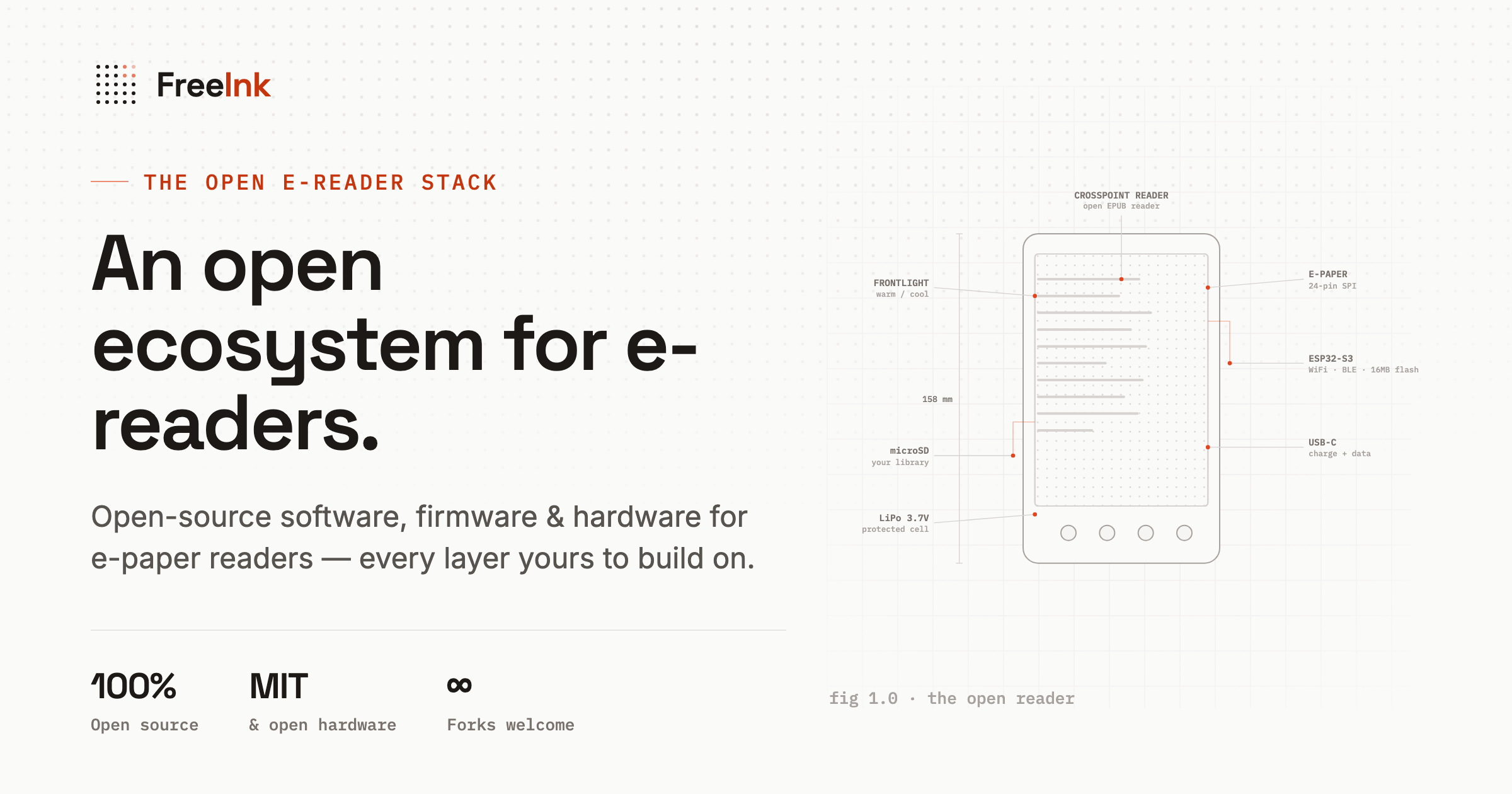
Free Ink is an open-source collective building the software, firmware and hardware for e-paper readers — every layer ships in the open for anyone to pick up, extend and make their own.
I see it as more of a simplification of things. An e-reader was just supposed to be a digital book reader with an e-ink screen, good battery life and possibly a backlight. Current e-readers OTOH function more like a phone with a screen that wasn’t meant to support such an experience. I’m not interested in browsing the web, playing games, and listening to music on something like this when there’s already a perfectly functional phone in my pocket.
Using an ESP32 just shows that we can strip away all the bells and whistles to keep the core experience of reading a book with an energy efficient architecture.
Thanks for the enlightenment. I hope things like TTS are treated as first party citizens though rather than an afterthought as that’s primarily how I consume novels.

Sorry, what does that mean in layman’s terms? It sounds like a step backwards?
I see it as more of a simplification of things. An e-reader was just supposed to be a digital book reader with an e-ink screen, good battery life and possibly a backlight. Current e-readers OTOH function more like a phone with a screen that wasn’t meant to support such an experience. I’m not interested in browsing the web, playing games, and listening to music on something like this when there’s already a perfectly functional phone in my pocket.
Using an ESP32 just shows that we can strip away all the bells and whistles to keep the core experience of reading a book with an energy efficient architecture.
Thanks for the enlightenment. I hope things like TTS are treated as first party citizens though rather than an afterthought as that’s primarily how I consume novels.