I ate so well for a few months as a student until the local Waitrose started chaining their bins shut. Quite a lot of people did in fact, which is presumably why they started chaining them shut.
At least one local hypermarket does sell food at discounted price before they go off. Some poorer families rely on them.
Fred Meyer (owned by Kroger) sells close dated food at half price. Produce with blemishes is set aside and sold in reduced price bundles. I am sure they still throw away plenty of food, but the reduced prices do seem to attract buyers (myself included). Some items just never make financial sense at the regular price, but half price? I’ll take it.
My tiny local market does 40% off and then FREE for products near expiration.
Supermarkets should be able to write off the expenses (transportation, stagging, etc) related to donating soon-to-expire foods to food banks. And not just normal income deductions, but actual direct deductions from taxes. That is, if you spend $1000 loading and shipping expired food to the food bank, you pay $1,000 less in taxes.
Truly incentivize giving food to the poor.
It sounds great on the surface, but you just know there are total assholes out there who would exploit the system with artificially inflated shipping costs to the point where they’re hardly paying tax at all. This, as is commonly said, is why we can’t have nice things.
Yeah, there’s solutions to this problem and the idea that all of them don’t do this a failing of the store’s management.
France had to pass a law that banned food getting thrown out that could be given away.
I also noticed that Costco started offering more prepared chicken foods after it became more well known that their cheap rotisserie chickens would will dumpsters at the end of the day.
My friend was fired from Stop & Shop for taking some food that was going to be thrown away. He would never steal, really good dude. It was cooked food from the deli, and it can ONLY go into the dumpster if not sold. Sad indeed. They don’t pay much.
I work returns in a Costco. In fact, I’m typing this on my phone in the little office we have in receiving.
Food either gets sold or gets pulled for various reasons. Pulled food goes first to the local food banks. What can’t go to them goes to a farm, a local pet rescue group, and to a wildlife rescue and rehabilitation group.
Anything left over from all that goes into a bin to be turned into high grade compost, which gets sold for $5 for a 20lb bag.
It takes time and money to do this, and it gets done anyway because the will is there.

Me when there are Costcoposters
TBH though I love Costco. They actually pay their employees well, value their customers, and do things correctly. It’s living proof that things could be different it’s just a group of around 300 people set the incentive structures and propaganda used to program everyone and everything…
Well, before Costco I worked at Walmart. You can imagine the difference in environment
Yeah that would be like going from working in the 19th century to working at Costco
Don’t know about your shit hole state, but in EU trade of expired food is strictly forbidden.
Because of health concerns.
at least in Germany it is not strictly forbidden, but the responsibility switches from the manufacturer to the seller, which is why most stores just toss it in the bin.
Supermarkets destroy food if it doesn’t sell. We can always feed the world. We just don’t.
Somehow, I dyslexic speed-reading misread that at first as:
Supremacists destroy food if it doesn’t sell. We can always feed the world. We just don’t.
deleted by creator
You, households and restaurants, also throw away food. Putting this on supermarkets sounds a little too easy. The ones I know sell leftovers, give to charities, have bins for YOU to give to charity, and throw away food with contamination risk. The last thing we all want is to make “the world” sick and get sued for it. While we’re at it, check out the Food Hero App: https://www.foodhero.com/. There are some people who actually try.
It is not that easy. It is not a question of can we feed people but can we get the food to them. Produce that doesn’t sell is not going to last shipping again.
I don’t think critics realize supermarkets need their millions to buy the next batches of food.
If we build centers for distributing food people will come.
deleted by creator
Who will not eat fresh produce. It takes a lot of work to prepare a healthy meal from scratch; with employers not giving us enough time and money to invest into healthy, tasty, varied meals, people resort to eating junk.
Don’t worry, I’m sure that there are kitchens less than a day’s drive away
Yes, yes and of we made everyone who makes 250k/yr pay 3865$/mo for ubi income of 1800$/mo for everyone in the country it would work out. It would take like 5 years for a solid treasury/trust to accumulate. It would be able to happen though.
We have a couple of services where I’m at now, where as food approaches its best before date, it goes into the app where you can order it at a discount and then go pick it up in store. If it can be frozen, they’ll also freeze it to prolong its shelf life, like if it’s fresh sausages that aren’t selling.
I once got a large box of like 50 frozen burgers (frozen by default, not fresh to frozen) for like 80% off because they’d reached the best before on the box. They weren’t freezer burned or anything like that, they were perfect.
A lot of places would have just thrown that out.
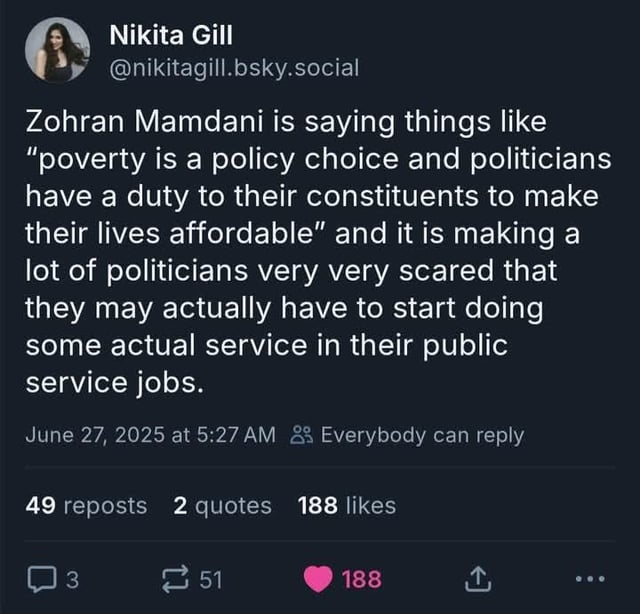
I love mamdani but “who” are these people that are scared that she’s talking about? I want names because I want some hope. Many of them openly don’t give a shit and literally say it…
You mean like the president who literally called his voters stupid and does exactly the detrimental shit to the country he ran his campaign on? Yeah, I get the skepticism, lol.
the peasant class exists to generate more money for the owner class, not the other way around.
always has been
I think also rich people need to have poor people otherwise they won’t be seen to be rich. Also wealth = power
Yeah. A rich person can’t exist when no-one’s poor.
you make a good point, but i think of “rich people” as the families who have been unimaginably wealthy for hundreds of years. not musk, not bezos, bill gates, etc. the “old money” doesn’t care if you know they’re rich–in fact they would prefer you didn’t. they just want to control the trajectory of your life in order to keep you in your place, and prevent you from encroaching on their position of power.
think warburgs and rothschilds, not the idiotic rich people flaunting their wealth on twitter
While raising their children, Bill Sr. and Mary instilled in them a strong work ethic, the importance of community and the significance of helping others.
https://people.com/all-about-bill-gates-parents-8624696that could all be a lie of course, who knows…
yes, bill gates’s parents were loaded. i’m talking about families that have been too wealthy to measure for many many generations, since banking was invented
Porque no los dos?
i mean, fuck musk and bezos and all the rest too. call me a conspiracy theorist, but i’m skeptical of the notion that these people are actually the “richest” of all rich people
Yeah but that’s the power part though
money and power are intimately connected, but they are not the same thing
Are you saying tech oligarchs don’t have as much desire or ability to control people’s lives and prevent threats to their power?
desire or ability to control people’s lives
no. the desire is there. and in some cases the ability too.
but they are still muppets, controlled by people more powerful than they are. the fact that elon musk, the “richest man in the world” doesn’t get everything he wants should tell you something.
you need to change your mindset away from thinking people like elon musk are the top of the food chain. he’s fucking not.
I hear what you’re saying, that at a certain level of wealth the power hierarchy becomes about seniority, and I don’t know that it’s wrong, but I’m not sure what reason there is to believe it either. Certainly people like elon musk are not all powerful, but what does that really say about the state of things when it would be hard to point to anyone who gets everything they want on a level beyond that?
i don’t get what your argument is. that we don’t objectively know who the people above elon musk are, so therefore they must not exist?
what DOES that say about the state of things? you tell me
Not a lot, as far as I can tell? I’m more expressing doubt than making an argument. You are claiming you know they do exist and what defines them, but I don’t see reasons to be confident about that.
Heaven forbid right?
yeah it’s politics’ job to feed everyone, agree. however, food waste in general is not the bad thing that you think it is.
food production naturally fluctuates. there have been over 20 volcano eruptions (example) in the last 2000 years that led to recorded famines. it’s only a matter of time till the next one happens. it’s not preventable, the only mitigation is to have enough surplus food production capability to make it through even if 30% of crops fails.
and having surplus food production capability necessarily leads to food waste.
and having surplus food production capability necessarily leads to food waste.
Nobody is complaining about that.
The complaint is that there is surplus production, and simultaneously 1. the production is actively wasted and destroyed, while 2. people are going hungry.
That’s like saying ‘your kid has a horrible disease, and in this syringe I have the cure for it, but I’m just gonna squirt it down the sink instead because why not’.
It seems to me that affordability starts with housing, because it is usually a household’s single largest monthly expense. And it seems to me the best way to make housing more affordable is to make it non-profit. That doesn’t necessarily mean city owned or other public housing, nor does it mean tax payer funded or subsidized housing, but having apartment buildings owned by a non-profit organization that charges tenants only enough rent to cover the organization’s expenses without any extra going to an owner as profit. And the thing, non-profit housing isn’t only theoretical. It exists right now, but it’s relatively rare. The reason is for-profit landlords don’t want it because they can’t compete.
Let’s say you have two identical apartment buildings, but one is owned by a non-profit housing cooperative and the other is owned by a private landlord. The non-profit housing cooperative is going to have the same ongoing expenses (property management, maintenance, etc) as the private landlord, because the apartments are identical, but rent will be lower at the non-profit housing because they charge only enough rent to cover expenses whereas the private landlord charges rent to cover expenses plus some for his own personal profit.
yeah, in germany a few weeks ago the news made the headline that for-profit rent-out company vonovia makes 30c profit for every 1€ revenue. that’s extreme. that means they’re charging almost 50% more than they had to to operate at-cost.
also in vienna there’s a lot of city-owned apartments and rents here are really affordable. sincerely, written from my 550€/month apartment (roughly $600/month)
also a huge roadblock to lower construction costs is unnecessary complex building codes, zoning laws, and again zoning laws.
- unnecessarily complex construction regulations for example include zoning laws that prescribe that you can’t build multi-family houses on a single lot. this means two houses instead of two apartments in one house, which makes construction significantly more expensive.
- zoning laws also forbid in many places for example to operate supermarkets close to where you live. this is mostly a problem in the US, not so much in europe. it means you have to drive everywhere, which makes your cost-of-living higher.
- zoning laws, again, prescribe things such as minimum lot-size, which means you only have the option to buy 1 large lot instead of 1 small lot, even if you would be content with a smaller house on a small lot. also if not enough area is designated in a city as land for building, then that means that there’s a lack of supply, which makes the land more expensive, which makes the house more expensive.